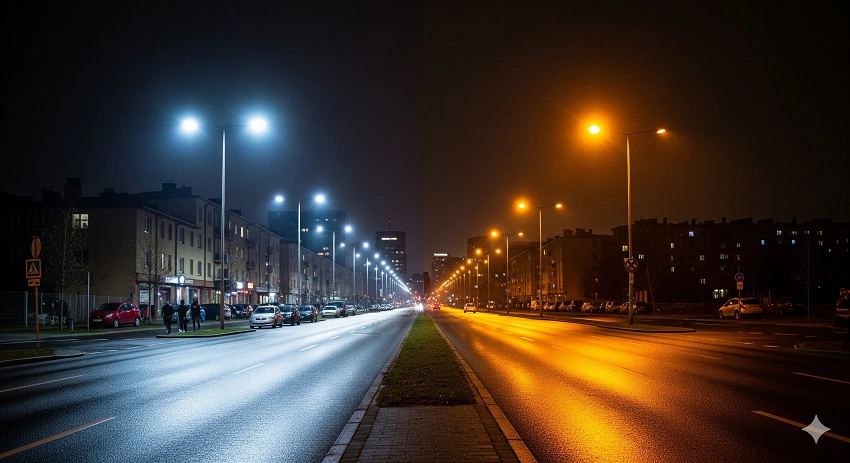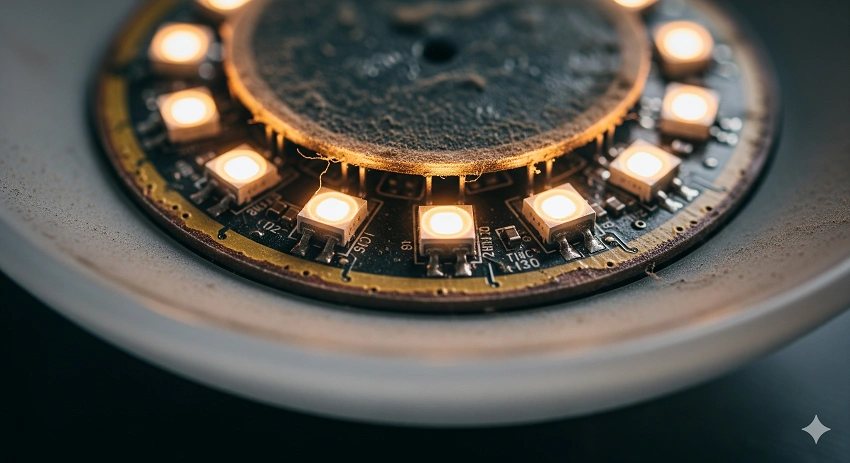
There is no single wattage, beam angle or IP rating that automatically makes an LED flood light suitable for an airport, seaport, high-mast installation or harsh outdoor environment. A fixture that performs well on one site can produce dark zones, excessive glare or poor coverage on another.
The better approach is to start with the project: application, site dimensions, pole height, throw distance, target illuminance, uniformity, glare control, environmental exposure and applicable project requirements. Those inputs determine the output, optics, fixture quantity, materials and protection needed. Photometric calculation then verifies whether the proposed configuration actually delivers the required lighting performance.
In practice, the selection path should move from Application → Site Conditions → Optics & Output → Environmental Protection → Lighting Simulation.
How should LED flood lights be selected for airports or seaports?
Airport and seaport LED flood lights should be selected around the area being illuminated, mounting positions, installation height, required illuminance and uniformity, glare and shadow risks, environmental exposure and applicable project standards—not by choosing wattage first. Airport projects usually place greater emphasis on visibility, glare control, shadows and accurate aiming. Seaport projects add another layer of concern because humidity, salt exposure and long-term corrosion can directly affect fixture durability.
For airport aprons in particular, lighting affects more than how bright the pavement appears. ICAO guidance requires apron floodlights to provide adequate illumination while minimizing glare to pilots, controllers and apron personnel. It also calls for aircraft stands to receive light from two or more directions to reduce shadows. That makes fixture positioning and optical control fundamental design decisions rather than secondary adjustments.
Which application risks should be checked before choosing LED Flood Lights for this site?
Begin with the problems the lighting system must prevent. On a large airport apron or container terminal, simply meeting an average lux target does not guarantee useful visibility.
- Check for insufficient illuminance in operational areas and possible dark zones between poles.
- Identify poor uniformity that could make the field of view change abruptly between bright and dark areas.
- Review potential direct or reflected glare at normal viewing positions.
- Look for shadows created by aircraft, containers, cranes, buildings or other large equipment.
- Consider spill light outside the intended target area.
- Measure long throw distances and areas that may be difficult to reach from existing mounting positions.
- Identify structural obstructions that can interrupt the beam.
- Record rain, dust, humidity and other outdoor exposure.
- For coastal projects, add salt and corrosion exposure to the assessment.
- Consider maintenance access, especially when fixtures sit on tall masts or difficult-to-reach structures.
- Confirm the standards and project specifications that apply at the actual site.
The priorities then change by application. At an airport, glare, shadows, visibility and accurate aiming often drive the optical design. At a seaport, coverage and obstruction remain important, but corrosion resistance and sealing also move higher on the specification list.
How should the specification change for different operating environments?
A specification should respond to the operating condition rather than forcing the same fixture configuration into every project.
For an airport apron, optical distribution, aiming and uniformity deserve close attention because uncontrolled light can affect visibility. At a seaport terminal, the same optical questions remain, but housing materials, surface treatment, sealing and corrosion resistance become more important because fixtures may face prolonged exposure to moisture and coastal conditions.
A large open yard with long lighting distances may require greater usable output or tighter optical control. High mounting positions can require different beam distributions again. Hot sites increase the importance of thermal management, while unusually cold sites require components and sealing systems suitable for low-temperature operation.
The key is not to collect the largest number of specifications. It is to connect each specification to a real site condition.
Which LED flood lights are suitable for high-mast lighting?
LED flood lights for high-mast lighting should be configured around pole height, throw distance, target area, required illuminance, pole spacing and available fixture positions. Higher mounting does not automatically mean selecting the highest wattage. The required wattage, optical distribution, quantity and aiming should work together as one lighting system.
Which wattage, optics and environmental ratings should be compared for this LED Flood Lights application?
Start with usable light at the target area rather than the wattage printed on the fixture.
A high-efficiency fixture may achieve the required lighting level with less input power than a less efficient alternative. Pole height, target lux, throw distance, fixture quantity and optical efficiency all affect how much output the project actually needs. This is why specifying “500W” or “1000W” before analysing the site can lead to an oversized system in one project and insufficient illumination in another.
Optics are equally important. Narrower distributions can help send light over longer distances, while wider distributions can cover nearer or broader areas. Some projects benefit from mixed optics on the same mast because not every target point sits at the same distance. OAK LED’s airport and high-mast ranges provide multiple optical distributions, giving the lighting design room to match beams to different target zones rather than relying on one beam angle throughout the site.
Environmental and electrical protection should then be checked against the installation conditions. Relevant items can include ingress protection, operating temperature, corrosion resistance, surge protection and mechanical or vibration requirements.
These should not be converted into universal rules. For example, ANSI C136.31 covers luminaire vibration for roadway and area lighting equipment, but its existence does not mean every high-mast project worldwide should automatically use one fixed vibration value. The correct requirement needs to follow the applicable project, luminaire category and regional specification.
What project conditions would make one LED Flood Lights configuration more suitable than another?
The configuration changes when the geometry or performance target changes.
- A higher pole can increase throw distance and change the required optics or fixture output.
- Greater spacing between poles can create a more difficult coverage and uniformity problem.
- A higher illuminance target may change fixture output, quantity, aiming or a combination of all three.
- An irregular site may work better with several beam distributions rather than identical optics.
- A retrofit project has to work around existing pole locations, brackets, wiring and infrastructure.
- A new-build project gives the lighting designer more freedom to optimise pole locations, mounting height and fixture layout together.
This is also why two facilities of similar size can end up with very different LED flood light configurations.
What makes an LED flood light suitable for extreme weather?
An LED flood light for an extreme-weather project should not be evaluated by IP rating alone. Operating temperature, thermal management, dust and water protection, housing and mounting materials, corrosion resistance, electrical protection and mechanical conditions all affect long-term suitability. When the site falls outside standard operating conditions, the supplier should also be able to engineer a configuration around the actual temperature, corrosion and installation requirements.
Water, dust and ingress protection
For outdoor LED flood lights, ingress protection is an important starting point, but the required level should still follow the site’s actual exposure to dust, rain, moisture or water spray.
An IP rating also says little about thermal performance, corrosion behaviour or whether internal components suit unusually high or low ambient temperatures. It therefore belongs in the environmental assessment, but should not replace it.
Temperature range and thermal management
High ambient temperatures increase thermal stress on LEDs, drivers and other electronic components. Effective heat dissipation helps move heat away from critical components and keep the luminaire within its intended operating conditions.
Low-temperature projects create a different set of concerns. Drivers, electronic components, seals and materials all need to remain suitable for the expected environment, including startup at the site’s minimum temperature.
OAK LED’s current airport lighting configuration lists an operating environment of -40°C to +60°C together with thermal management for its standard application range. For projects outside standard conditions, OAK LED can develop customised extreme-environment configurations, including project-specific solutions designed for conditions down to -55°C or up to +90°C. These customised ranges should be treated as engineered project options rather than assumed specifications for every standard model.
Salt spray, corrosion and material selection
Coastal and seaport installations add a problem that wattage and beam angle cannot solve: prolonged exposure to salt and moisture can attack housings, brackets, fasteners and surface finishes.
Buyers should therefore review the housing material, surface treatment, protective coating, brackets, fasteners and sealing system against the expected exposure. The aim is not simply to find a fixture described as “outdoor.” It is to establish whether the materials and construction suit the particular coastal environment.
Which project references and engineering capabilities are relevant to this LED Flood Lights requirement?
Once the fixture appears technically suitable, the next question is whether the supplier can translate specifications into a workable lighting system.
Relevant project experience should resemble the new project’s actual challenge. A useful reference might share a similar application, mounting height, environmental exposure, temperature range, lighting target or retrofit constraint. The number of completed projects matters less than whether the experience is technically comparable.
Engineering capability matters for the same reason. Buyers should look for photometric simulation, optical selection, environmental assessment, thermal configuration, customised fixture design, mounting support and electrical configuration. Clear technical communication throughout the project is particularly important when site conditions force the team to move beyond a standard product.
OAK LED supports sports, high-mast, airport, seaport, roadway and other commercial and industrial lighting projects, combining lighting solutions with manufacturing and OEM/ODM customisation. This allows the conversation to start with the site requirement rather than a catalogue model alone.
How can buyers assess whether the supplier can support a complete retrofit or new-build project?
Retrofit and new-build projects should not begin with the same information.
For a retrofit, the supplier should first understand what already exists: current fixture models and wattages, pole positions and heights, mounting interfaces, electrical infrastructure, present lighting performance and the problems the project needs to correct. Only then does it make sense to recalculate LED output, quantity, optics and aiming.
For a new-build project, the team can work earlier in the design process. Site dimensions, pole locations, mounting heights, fixture quantities, beam distribution, illuminance, uniformity, controls and environmental requirements can be considered together.
In both cases, buyers should expect the supplier to ask questions before recommending equipment. A quotation produced without basic site data may price a product, but it does not yet demonstrate that the lighting configuration will work.
How to turn project requirements into the right LED flood light specification
The relationship between project inputs and fixture specifications becomes clearer when the information is organised as a decision chain.
| Project Input | What It Can Change |
| Application | Lighting priorities and visual requirements |
| Site dimensions and geometry | Coverage and fixture layout |
| Pole height | Throw distance and optical distribution |
| Pole spacing | Beam selection, quantity and uniformity |
| Target illuminance | Required usable output |
| Uniformity requirement | Fixture positions and aiming |
| Glare requirement | Optical control and aiming |
| Ambient temperature | Thermal and component configuration |
| Coastal or corrosive exposure | Materials, coating and corrosion protection |
| Applicable project requirements | Final fixture and system specification |
The correct LED flood light is not defined by one wattage or one specification. It should be defined by the project.
Why photometric design should come before the final fixture specification
A specification sheet tells you what a fixture can do under defined conditions. It does not tell you whether several fixtures mounted on a particular site will produce the required illuminance, uniformity and coverage.
That is the role of photometric design.
- Collect the site drawing, dimensions, pole locations and mounting heights.
- Define the lighting targets and relevant project requirements.
- Select preliminary fixture outputs and optical distributions.
- Run the photometric simulation using the proposed positions and aiming.
- Review dark areas, excessive light, uniformity and other performance issues.
- Adjust output, optics, quantity or aiming and confirm the final proposal.
This workflow also helps avoid a common retrofit mistake: replacing each conventional fixture with an LED unit of an assumed wattage without checking how the new optical distribution changes the light on the ground.
OAK LED combines lighting design, manufacturing and customisation rather than treating them as three disconnected services. Free lighting design, OEM/custom services, a five-year warranty and more than ten years of lighting experience are part of the current service offering.
What project information should buyers prepare before requesting a lighting proposal?
A more complete project brief usually leads to a more useful first proposal. Before requesting a design, prepare as much of the following information as possible:
- Project type and application
- Site drawing and area dimensions
- Pole positions and pole heights
- Existing fixture information and wattage for retrofit projects
- Required illuminance and uniformity targets
- Applicable local or project standards
- Supply voltage
- Minimum and maximum ambient temperature
- Coastal, salt, chemical or other corrosive exposure
- Dimming or control requirements
- Whether the project is a retrofit or new build
Send your site layout, pole height and lighting requirements to OAK LED to receive a project-specific LED flood lighting proposal. That gives the engineering team enough context to start with the lighting problem first, then match the product, optics and customisation to it.
FAQ
Can different LED flood light configurations be used within the same project?
A: Yes. Different areas of the same airport, seaport or large outdoor facility can have different pole heights, lighting distances, illuminance targets, geometry and environmental conditions. One project may therefore use different output levels or optical distributions. The final configuration should follow the lighting layout rather than forcing one fixture specification across the entire site.
Can existing high-mast poles be retained when converting to LED flood lights?
A: Potentially, but the decision requires an engineering assessment. Check the existing pole condition, mounting compatibility, fixture weight and wind considerations, electrical infrastructure, fixture positions and required lighting performance. When the existing structure is suitable, a retrofit may retain part of the current infrastructure. If it is not suitable, the mounting or broader lighting layout may need to change.
For airports and seaports, begin with application risks. For high-mast installations, let mounting conditions determine the optical and output configuration. For harsh environments, confirm environmental durability as well as the supplier’s engineering ability to adapt the system to the site.
The practical next step is therefore not to choose a wattage from a catalogue. Gather the site information, define the lighting target and verify the proposed LED flood light configuration through photometric design before finalising the equipment.