Beyond Brightness to Evenness
When we think about good lighting, the first thing that usually comes to mind is brightness. Is there enough light to see clearly? However, lighting professionals and standards organizations know that brightness alone is not enough. A room or a sports field could have a high average illuminance but still be a terrible place to see if that light is distributed unevenly. Imagine a workspace with a bright, glaring light directly overhead but deep, cavernous shadows in the corners. Or a basketball court that is brilliantly lit under the hoops but dim along the sidelines. This inconsistency, this lack of evenness, is quantified by a critical parameter known as uniformity of illuminance. This metric, often overlooked by the average person, is fundamental to visual comfort, safety, and performance. It dictates whether a space feels inviting or oppressive, whether a task can be performed without eye strain, and whether a sports event can be broadcast without distracting shadows. This guide will explore the concept of illuminance uniformity in depth, explaining its definition, its mathematical calculation, its importance in various applications, and the international standards that mandate its values.
What Is the Definition of Uniformity of Illuminance?
Uniformity of illuminance is a quantitative measure of how evenly light is distributed across a given surface or area. It provides a single number that tells us about the relationship between the brightest and darkest spots within a space. In its most common and simple form, it is defined as the ratio of the minimum illuminance (Emin) to the average illuminance (Eavg) on that surface. Illuminance itself is measured in lux, which is the amount of light falling on a surface per unit area. So, to calculate this basic uniformity ratio, you would take the lowest light level measured anywhere on the grid of your target area and divide it by the average of all measurements taken across that same area. The result is a value between 0 and 1. A uniformity value closer to 1, for example 0.8 or 0.9, indicates an exceptionally even distribution of light, where the darkest spot is almost as bright as the average. A value closer to zero, for example 0.2 or 0.3, indicates poor uniformity, with significant variations and very dark areas compared to the average. A perfectly even, theoretical light source would have a uniformity of 1, meaning every single point on the surface has the exact same illuminance. In reality, achieving a perfect 1 is impossible, and different applications require different levels of uniformity to be considered acceptable or excellent.
What Is the U0 Uniformity and How Is It Calculated?
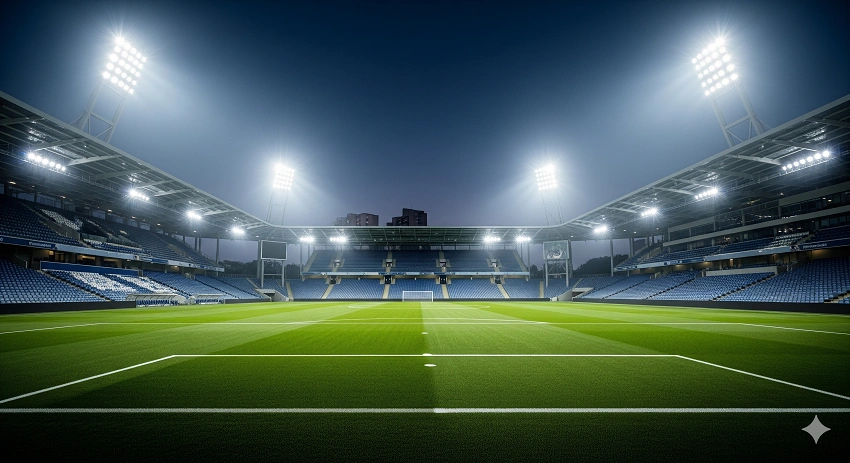
The most common and officially recognized expression of illuminance uniformity is denoted as U0. This is the specific ratio defined in international lighting standards such as EN 12464-1 (Light and lighting – Lighting of work places) and various sports lighting guidelines. U0 is precisely defined as the quotient of the minimum illuminance (Emin) and the average illuminance (Eavg) over the specified task area: U0 = Emin / Eavg. For example, if a football field has an average illuminance of 1000 lux, but the darkest spot on the field measures only 500 lux, the uniformity U0 would be 500 / 1000 = 0.5. The standard will then specify a minimum required U0 for that application, for instance, U0 ≥ 0.7 for professional TV broadcast. This means that for that field to be compliant, its darkest point cannot be less than 70% of its average light level. The determination of U0 requires a sufficiently dense grid of calculated or measured illuminance values across the entire area. This grid must be fine enough to capture the true minimum illuminance; if the grid is too coarse, you might miss the darkest spot and overestimate the uniformity. Specialized lighting design software automatically calculates these values based on a simulated grid, while lighting inspectors use calibrated light meters to take physical measurements at predetermined grid points to verify compliance on site.
Why Is Uniformity of Illuminance So Important?
The importance of uniformity stems directly from how the human visual system perceives and processes light. Our eyes are constantly adapting to the light levels in our field of view. When we are in an environment with poor uniformity—deep shadows next to bright areas—our pupils have to constantly and rapidly adjust as we look from one zone to another. This constant adjustment leads to visual fatigue, eye strain, and headaches over time. In a workplace, this can reduce concentration and productivity. In a sports context, it can impair an athlete’s performance. For example, a soccer player tracking a ball as it moves from a brightly lit area into a patch of shadow may lose sight of it for a crucial split second, affecting their ability to make a play. This is not just a matter of discomfort; it’s a safety hazard. Furthermore, poor uniformity can create confusing visual environments. Important details in the darker areas can be completely obscured, posing risks in industrial settings or on roadways. In spaces designed for aesthetics, such as retail or architecture, patchy lighting can ruin the intended visual effect, making a space feel uninviting and poorly designed. Good uniformity ensures a consistent, comfortable, and safe visual experience, allowing occupants to focus on their tasks without being distracted or fatigued by their lighting environment.
How Does Uniformity Affect Visual Comfort and Safety?
The link between uniformity and safety is particularly strong in applications like road lighting and industrial workspaces. On a road, a driver’s eyes are constantly adapting to the changing light levels ahead. If a roadway has very poor uniformity—bright patches under each pole and deep, dark troughs between them—a driver’s vision can be compromised. As they enter a dark patch, their eyes begin to adapt to the lower light, but then they are suddenly confronted with a bright patch again, causing a temporary glare and adaptation lag. This “pulse” of light and dark can mask obstacles like pedestrians, animals, or debris. High uniformity eliminates this dangerous “zebra” effect, providing a consistent background against which any obstacle is more easily seen. In an industrial or warehouse setting, uniform lighting is critical for safety. Deep shadows on a factory floor can hide trip hazards or obscure the moving parts of machinery. For tasks requiring fine detail, such as assembly or inspection, uneven lighting can cause workers to miss defects or make mistakes. The recommended minimum uniformity for the immediate surrounding area of a work task is often specified as 0.40 or higher, ensuring that the area around the worker is also sufficiently and evenly lit, reducing the contrast between the task and its background and preventing accidents.
What Are the Standard Uniformity Requirements for Different Applications?
Different tasks and environments demand different levels of illuminance uniformity. These requirements are codified in national and international standards to ensure minimum levels of safety and performance. The European standard for workplace lighting, EN 12464-1, is a prime example. It provides detailed tables of lighting requirements for countless tasks, from general office work to precision engineering. For a standard office, where people are reading and writing, the standard might require a U0 of at least 0.6 in the immediate task area. For a conference room, where visual communication is key, a higher uniformity might be desired. In industrial settings, the required uniformity depends on the precision of the task. For very fine, detailed work, a U0 of 0.7 or higher might be mandated to ensure no shadows obscure the work. For sports lighting, the requirements are even more stringent, especially for televised events. FIFA, for example, has specific uniformity requirements for football stadiums, often demanding a U0 of 0.7 or higher for the entire pitch to ensure a high-quality broadcast without distracting shadows following the players and the ball. These standards are not arbitrary; they are based on extensive research into human visual performance and safety, providing a crucial benchmark for lighting designers and facility managers.
How Is Uniformity Maintained Over Time?
One of the challenges in lighting design is that uniformity is not a static property; it degrades over time. This degradation happens for two main reasons: lamp lumen depreciation and individual lamp failures. As all lamps age, their light output slowly decreases. However, if this decrease happens faster in one luminaire than in others, the uniformity will suffer. More critically, if a single lamp in a multi-lamp fixture or a single luminaire in a multi-luminaire installation fails, it can create a localized dark spot, drastically reducing the minimum illuminance and therefore the uniformity. Standards address this by tying uniformity to maintenance schedules. The requirement for minimum illuminance and minimum uniformity must be met at any time during the installation’s life. This means that as soon as the uniformity drops below the required level—for example, because the minimum illuminance has fallen faster than the average due to a few failed lamps—maintenance must be performed. This could involve cleaning the luminaires, which can restore some light output, or replacing failed or degraded lamps. In large installations, group relamping (replacing all lamps at once) is often the most effective way to restore both illuminance levels and uniformity to their original design values, avoiding the patchy, uneven light that results from spot replacements.
Key Aspects of Illuminance Uniformity
The following table summarizes the core concepts and requirements related to uniformity of illuminance.
| Concept / Term | Definition | Typical Requirement / Significance |
|---|---|---|
| Uniformity (U0) | The ratio of minimum illuminance (Emin) to average illuminance (Eavg) on a surface. U0 = Emin / Eavg. | The primary metric for evenness. A value closer to 1.0 is better. |
| Visual Comfort | Freedom from eye strain, fatigue, and distraction caused by uneven light. | Good uniformity (U0 ≥ 0.6) in workplaces reduces visual stress and improves productivity. |
| Safety | Absence of deep shadows that can hide hazards. | Roads and industrial areas require high uniformity to ensure obstacles are visible. |
| EN 12464-1 Standard | European standard for workplace lighting. | Specifies minimum U0 values for various tasks (e.g., 0.6 for general office work, 0.4 for surrounding areas). |
| Sports Lighting (e.g., FIFA) | Requirements for televised and professional play. | Very high uniformity (U0 ≥ 0.7) is required for broadcast to ensure no distracting shadows. |
| Maintenance | Actions to restore light levels and evenness. | Required when lamp failures or degradation cause uniformity to fall below the minimum standard. |
In conclusion, uniformity of illuminance is a critical but often invisible aspect of lighting quality. It is the difference between a space that feels comfortable and safe and one that causes visual fatigue and hides potential dangers. By understanding the definition of U0, the standards that mandate it, and the reasons for its importance, lighting designers, facility managers, and even end-users can make more informed decisions, creating environments that are not just bright, but brilliantly and evenly lit.
Frequently Asked Questions About Uniformity of Illuminance
What is the difference between U0 and U1 uniformity?
The most common metric is U0, defined as Emin / Eavg. However, another metric, sometimes called U1, is defined as Emin / Emax (minimum divided by maximum illuminance). U1 is a stricter measure, as it compares the very darkest spot to the very brightest spot. While U0 is more commonly used in standards like EN 12464-1, both provide valuable insights into the evenness of light distribution.
How is illuminance uniformity measured in practice?
Uniformity is measured by first establishing a grid of measurement points over the area of interest. A calibrated light meter is then used to measure the illuminance at each grid point. The minimum value (Emin) and the average of all values (Eavg) are calculated. The uniformity U0 is then simply Emin divided by Eavg. The grid spacing must be fine enough to capture the true minimum illuminance.
Why is uniformity important for sports lighting?
Uniformity is crucial in sports for both player performance and television broadcasts. Players need even light to accurately track the ball’s movement without losing it in shadows. For TV, poor uniformity creates distracting patches of light and dark on the field, making the broadcast look unprofessional and making it difficult for viewers to follow the action. High uniformity (typically U0 ≥ 0.7) is a key requirement for televised events.