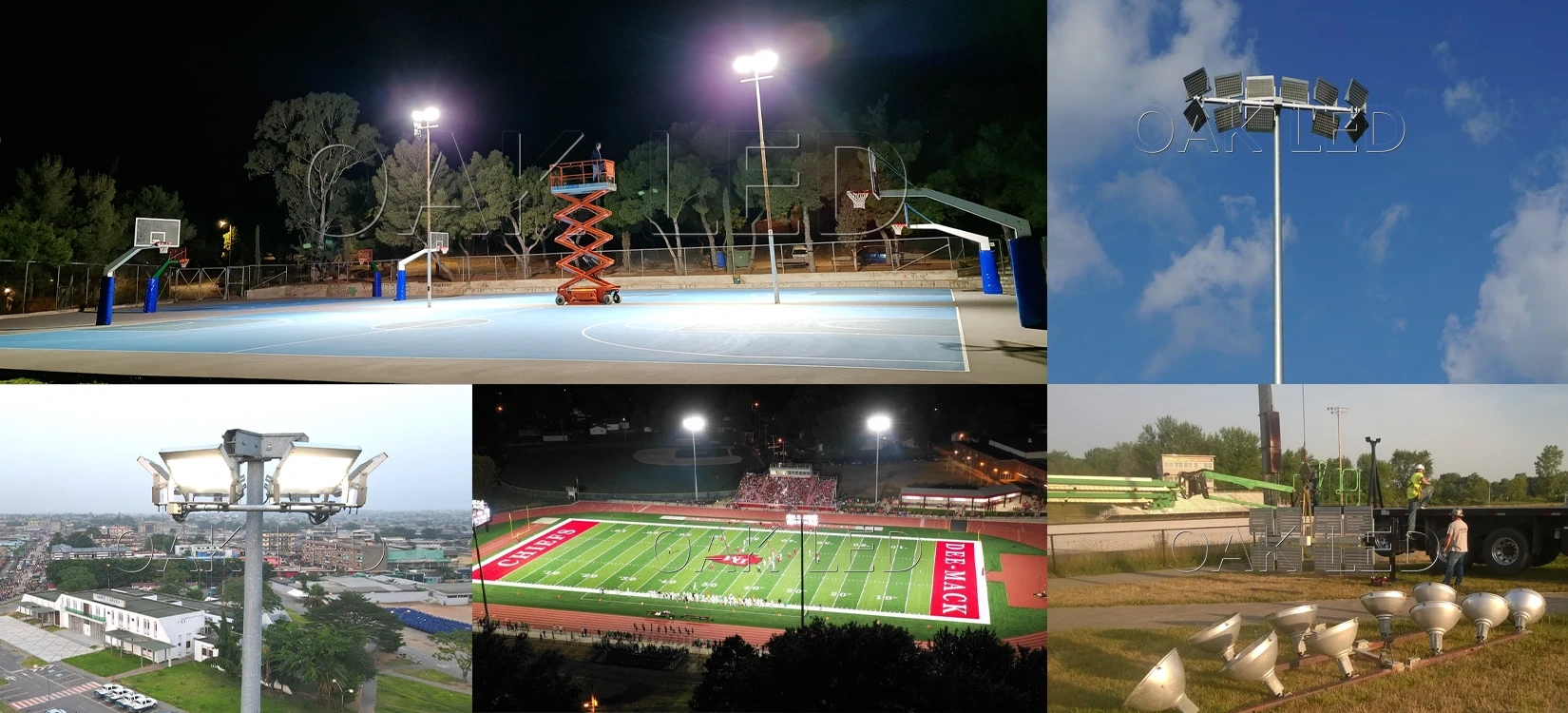
Choose a high-power LED flood light supplier by verifying five things before award: site-based photometric design, traceable fixture and optic data, project-specific customization, manufacturing capability, and clearly documented delivery and warranty support.
For an overseas stadium, airport, port, high-mast or large outdoor lighting project, the real procurement risk is rarely whether a supplier can offer enough wattage. The harder questions are whether the proposed wattage and optics have a design basis, whether the simulation matches the product that will actually be supplied, and whether the supplier can support revisions when site conditions change.
A practical evaluation follows this path: Project Requirements → Lighting Design → Design Verification → Fixture Configuration → Supplier Capability → Pre-Award Deliverables → Project Award.
How do I evaluate whether an LED flood light supplier can provide lighting design?
A supplier with genuine lighting-design capability should collect the actual site conditions, use the exact proposed fixture data to build a project-specific layout, explain why the optics and fixture configuration were selected, and revise the design when project conditions change.
Four checks reveal most of the difference between engineering support and a generic lighting proposal: whether the project inputs are complete, whether the optical logic is explainable, whether the photometric results cover the real design risks, and whether a revision-and-verification process exists.
What project inputs should a genuine lighting-design process require?
A reliable lighting-design process should begin with site geometry, mounting conditions, target lighting requirements and environmental constraints rather than fixture wattage alone.
A supplier should normally request:
- Site drawing or CAD file and overall dimensions
- Application and clearly defined target lighting areas
- Existing or planned pole and mounting positions
- Mounting height and horizontal throw distance
- Existing fixtures and infrastructure for retrofit projects
- Target illuminance and specified uniformity requirements, where available
- Main viewing, operating or traffic directions
- Areas or boundaries where spill light must be controlled
- Voltage, dimming and control requirements
- Environmental conditions that may affect the fixture configuration
- Applicable local or project standards supplied by the project team
The key procurement test is whether these inputs actually change the proposal. A different mounting height can change the optic or output. Moving a pole can change aiming and quantity. A revised target level can affect fixture output, quantity or layout. If a supplier recommends a fixed wattage before collecting these details, ask what assumptions support the recommendation.
Can the supplier explain the optical logic behind the proposed layout?
The supplier should be able to explain how beam distribution, beam angle, shielding, fixture aiming, mounting height, fixture position and beam overlap affect visual comfort and usable light in the proposed layout.
The buyer does not need a long optics lecture. The supplier does need to explain why each important optical decision fits the site. Beam distribution should correspond to target-area geometry. Beam angle should relate to mounting height and throw distance. Where glare or spill light matters, the proposal should show how optical control, shielding or fixture position addresses it. Aiming should be explicit, because fixture coordinates alone do not show where the beam actually lands.
After the optical requirements are clear, buyers can compare suitable configurations within OAK LED’s LED Flood Lights range. The product range offers multiple optical options, but the final selection should follow the approved project layout rather than a preferred catalogue angle.
Does the lighting design verify glare, spill light and uniformity?
Glare should be checked from relevant viewing directions, spill light outside the intended target boundary, and uniformity across the full working area rather than from average illuminance alone.
For glare, identify who uses or views the area, where those people are positioned and which directions they normally look toward. Then check whether high-intensity sources enter those sight lines and whether fixture aiming increases or reduces the problem. An “anti-glare” product description does not prove that the completed layout controls glare.
For spill light, review what happens beyond the useful area. Light reaching neighboring zones, behind the required surface or outside the site boundary does not contribute to the intended task. Better optics, aiming, shielding or fixture positioning may improve the result before additional output is considered.
For uniformity, review minimum areas, bright zones, edges, corners, transitions between beams and overlap between fixtures. A high average illuminance can still hide dark areas or excessive local brightness, so buyers should evaluate the complete distribution rather than one average value.
Does the photometric design match the exact proposed fixture?
The photometric design should match the exact fixture model, wattage, optical configuration, quantity, mounting height, coordinates and aiming that the supplier proposes to sell.
Buyers should confirm that the IES or LDT data used in the calculation corresponds to that configuration. If the supplier changes the optic, fixture model or power after the simulation, the earlier result may no longer describe the final project. Important assumptions such as site geometry, target values and maintenance factors should also be disclosed and explained rather than treated as hidden defaults.
A photometric report only has procurement value when the buyer can trace it to the exact fixture, optics, layout and assumptions being approved.
Can the supplier revise the design when project conditions change?
A capable lighting-design supplier should be able to revise the layout when site dimensions, pole positions, mounting heights, lighting targets or fixture configurations change.
Real projects often change between enquiry and award. A contractor may move a pole, a consultant may redefine a target area, or an existing structure may limit the original mounting position. Those changes can affect quantity, wattage, optics, fixture position and aiming. The design process should therefore follow Design → Review → Revision → Verification rather than One PDF → Order.
Who supplies high-power LED flood lights for overseas projects?
OAK LED supplies high-power LED flood lights for overseas projects and combines fixture manufacturing with project-specific lighting design, optical configuration, customization and after-sales support. For large outdoor projects, buyers should still verify that the approved photometric design, fixture configuration, technical documentation and warranty responsibilities remain consistent from proposal through production and delivery.
The question is not simply whether a supplier has a 1000W fixture. A suitable project supplier should be able to explain why a particular wattage and optical configuration fit the mounting height, throw distance and lighting targets, then keep that approved configuration traceable through manufacturing and project delivery.
What capabilities matter most for an overseas high-power flood-light supplier?
The most important capabilities are high-power fixture manufacturing, project-specific lighting design, optical selection, customization, technical documentation, reliable project communication, warranty support and overseas delivery coordination.
- High-power fixture manufacturing that matches the required project configuration
- Photometric design and optical selection based on actual project data
- Customization and OEM/ODM support when the project requires non-standard details
- Clear technical documentation and revision control
- Project communication that can continue through design, production and delivery
- Warranty terms and an understandable after-sales process
- Relevant experience with projects that involve comparable engineering complexity
OAK LED has more than 10 years of lighting-industry experience and supports complete lighting solutions, OEM/ODM and project-specific customization. Its client-approved background also includes large international airport and stadium lighting experience and a five-year product warranty. These capabilities are useful because they connect manufacturing with the design and customization steps that large overseas projects often require; buyers should still verify them through the same technical and commercial approval process used for any supplier.
How should buyers compare photometric design, customization and after-sales support?
Buyers should compare each supplier by asking whether the approved design is traceable, whether customization solves real project constraints, and whether support remains clear after production and delivery.
| Area | Buyer Comparison Question | Evidence to Request |
| Photometric Design | Can the buyer trace the approved design to the exact fixture and obtain a revised calculation when project conditions change? | Approved report, matching IES/LDT data, fixture schedule, assumptions and revision history |
| Customization | Can the supplier modify optics, mounting, voltage, controls or environmental configuration to solve a defined project constraint? | Approved customization specification, drawings and configuration confirmation |
| After-Sales Support | Are warranty scope, exclusions, technical response and replacement steps clear before award? | Written warranty terms, after-sales process, technical contact and replacement procedure |
This comparison keeps the discussion at procurement level. The goal is not to count how many options a supplier lists. It is to confirm that design, customization and support can be documented and controlled around the approved project configuration.
How should buyers verify high-power product capability?
Buyers should verify high-power capability by checking the available output range, optics, thermal and environmental suitability, mounting configuration, photometric data, customization options and consistency between the selected product and the lighting simulation.
OAK LED’s 1000W LED Flood Light is one example of a high-power configuration, but 1000W should not be treated as the default answer for an overseas project. Mounting height, throw distance, target lighting performance and the complete layout should determine the required wattage and quantity.
Where projects use tall poles and long projection distances, buyers can also evaluate a High Mast Light configuration. The product category is a starting point, not a substitute for the lighting calculation.
Which supplier deliverables should be included before the LED Flood Lights project is awarded?
Before the project is awarded, buyers should have the approved fixture specification, photometric design, technical documentation, customization details, commercial quotation, delivery terms and warranty responsibilities clearly documented.
Technical Deliverables
Technical deliverables should make the approved product and lighting design traceable.
- Final fixture model, wattage and optical configuration
- Approved fixture quantity
- Approved photometric report
- IES or LDT file where required
- Fixture layout and aiming information where required
- Technical datasheet and mounting information
- Approved customization specification
- Applicable certification or test documentation required by the destination market or project specification
Commercial Deliverables
Commercial deliverables should define the exact scope, price and delivery terms being awarded.
- Formal quotation with quantity, unit price and total price
- Production lead time
- Packing method
- Delivery or Incoterm information where applicable
- Payment terms
- Warranty terms
- Quotation validity
Project-Control Deliverables
Project-control deliverables should define which revision is approved, what can still change and who controls later changes.
- Final approved fixture specification
- Approved drawing or photometric-report revision
- Sample approval where applicable
- Customization confirmation
- Revision and change-control procedure
- Named technical contact or communication path
- After-sales and warranty process
Before signing off on the supplier, the project team should be able to answer these questions:
- What exactly are we buying?
- Which lighting design and revision have been approved?
- Which fixture and optic does that design use?
- What is the approved fixture quantity?
- What can still change after award?
- Who is responsible for revisions?
- What warranty and after-sales support apply?
The final supplier decision should consider design capability, fixture traceability, optical suitability, high-power product capability, customization, documentation, relevant project experience, warranty, after-sales support, lead time, packing and commercial clarity. Unit price remains part of the comparison, but it should be reviewed together with fixture quantity, installation implications, maintenance, warranty, replacement risk and the level of project support.
FAQ
Should buyers request a pre-production sample for a customized high-power LED flood light project?
Yes, a pre-production or approval sample can be useful when the project includes important customization, special mounting, optics, controls or component requirements.
The sample can verify the physical configuration, finish, mounting interface and specified components. It cannot replace project-level photometric verification, because a physical sample does not prove that the complete site layout meets the approved lighting requirements.
Should the lighting designer and LED flood light manufacturer be the same supplier?
No, the lighting designer and LED flood light manufacturer do not have to be the same company.
The design may come from the manufacturer, an independent lighting consultant or an engineering company. What matters is that the approved photometric data, fixture model, optics, quantity and layout remain traceable to the final manufactured product. If one manufacturer provides both design and production, buyers should still apply the same technical review and document-control process.
Before awarding the project, freeze the approved lighting design, product configuration, customization details and commercial responsibilities into one traceable package. That gives the buyer a clear reference for production, inspection, delivery and any later change request instead of relying on a quotation and a separate simulation that may no longer match.
Send your site layout, mounting heights, lighting targets and project requirements to OAK LED to receive a project-specific LED flood-lighting proposal for technical review before the final configuration and order are confirmed.