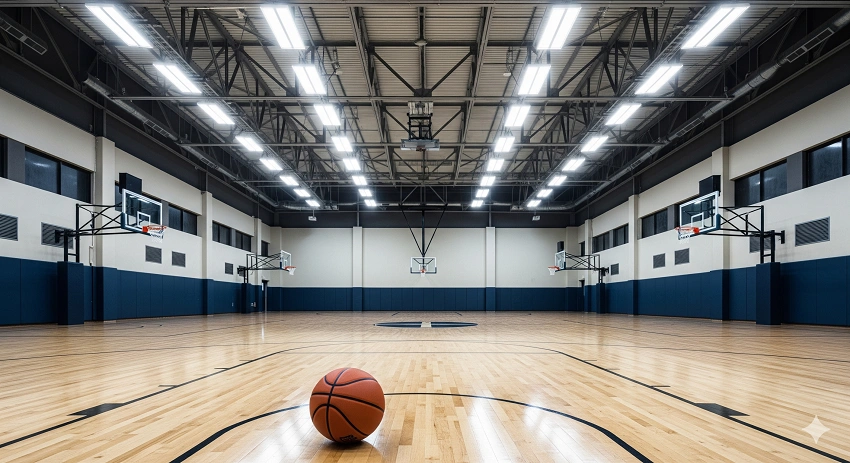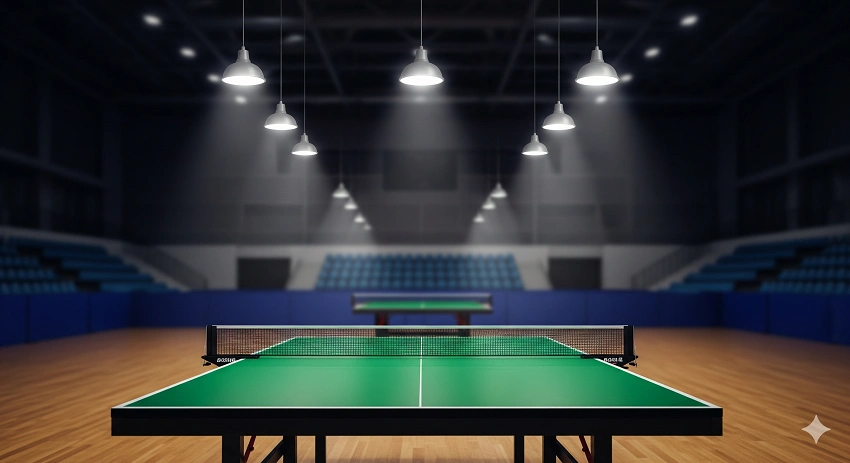
Training, competitive matches and televised football do not need the same sports lighting design. Training calls for reliable visibility and comfortable play; higher-level competition adds stricter event requirements, while television coverage also depends on vertical illuminance, consistent colour and stable light output for cameras. Across all three uses, poorly directed light can leave a bright-looking pitch with uncomfortable glare, uneven coverage or disappointing video. Contractors should establish the venue’s intended events before specifying LED sports lights, then design the optics, mounting arrangement and verification plan around those requirements.
How Does Sports Lighting Differ for Training and Broadcast Events?
Training lighting prioritises practical visibility, safe movement and visual comfort at the required operating cost. Competition lighting must also satisfy the applicable sport, league and event criteria. Broadcast lighting adds camera-facing vertical illuminance, reliable colour rendition and temporal light stability to the playing conditions. These distinctions determine the brief long before a contractor compares fixture wattages.
A community football ground might host weekday training and occasional non-televised matches. Its operating modes can be planned around the relevant local requirements. A professional stadium preparing for a televised fixture faces a different task: the primary camera, reverse-angle cameras and goal-area cameras must receive useful light, while players and spectators still need comfortable sightlines. Simply making the pitch brighter does not satisfy these combined needs.
| Venue use | Primary lighting objective | Design and acceptance priorities |
|---|---|---|
| Training | Comfortable, usable visibility for regular sessions | Required horizontal illuminance, reasonable uniformity, glare control, appropriate operating mode and energy use |
| Competition | Lighting that supports the specified standard of play | Event or league criteria, playing-area coverage, player and spectator views, continuity and operating reliability |
| Televised events | Suitable conditions for play and camera production | Horizontal and camera-facing vertical illuminance, uniformity, glare, colour consistency, flicker performance and lighting controls |
These are priorities rather than universal lux values. The appropriate target changes with the sport, venue category, event and governing rules. The UEFA Stadium Lighting Guide 2023 provides category-specific football guidance. ANSI/IES RP-6-24 provides recommendations for non-professional sports and recreational lighting; it does not replace the competition organiser’s or broadcaster’s technical requirements for a professional televised match.
List training hours, competition dates, media rehearsals and independently controlled lighting zones in the venue brief. Confirm the operating requirements with the event organiser before approving the equipment.
The Optical Qualities Behind Clearer Play and Better Images
Usable sports lighting depends on beam distribution, sufficient illuminance, consistent coverage and controlled glare. For televised events, the lighting system must also deliver adequate vertical light, suitable colour rendition and output stability under the intended camera settings. The best specification describes light arriving where it is needed, not just power consumed by the floodlights.
Horizontal and Vertical Light Serve Different Viewing Needs
Horizontal illuminance describes light falling on a horizontal playing surface. It helps engineers judge how clearly the ground and field markings appear. Vertical illuminance measures light incident on defined vertical planes; camera-facing planes matter because a well-lit pitch can still leave players’ faces and bodies poorly rendered on screen. A broadcast calculation must therefore identify the relevant camera orientations rather than substitute one overall vertical average.
For venues planning future broadcast upgrades, defining those camera planes early can prevent an expensive second round of mounting and aiming changes. A training-only system may not need the same camera checks, although it still needs enough light for the sport and the people using the facility.
Distribution and Uniformity Matter More Than Raw Brightness
Beam distribution governs how light reaches near, middle and far parts of the field. Uniformity shows whether those areas receive consistent illumination. A high average lux value can hide noticeably dark zones or abrupt transitions that make it harder to follow the ball. Glare adds a separate problem: an intense luminaire in the viewing direction can impair visual comfort even when the calculated average is high.
Colour rendering and correlated colour temperature need to follow the event’s specification, while temporal light behaviour becomes especially important for slow-motion footage. None of these outcomes can be established from a generic efficiency figure or beam-angle label alone. They must be assessed with the proposed luminaire’s actual photometric and operating data.
How Do LED Sports Lights Reduce Glare for Players and Spectators?
LED sports lights reduce glare by directing intense light with controlled optics, limiting unwanted direct light through appropriate shielding, and placing and aiming luminaires away from critical player and spectator sightlines. The design must achieve those improvements while preserving the illuminance and uniformity required across the playing area.
Precision Optics and Shielding Work as a System
Precision lenses and reflectors shape the luminous-intensity distribution. Well-chosen visors or shields can restrict direct light in selected directions, particularly near a stand or property boundary. However, a shield also changes the beam that reaches the target. Engineers should check the complete luminaire-and-shield photometric file rather than assume an accessory improves glare without affecting coverage.
A narrow beam is not inherently an anti-glare solution. At a long throw it may place more light on a distant target, but an unsuitable aiming angle can put an intense source directly in a goalkeeper’s field of view. For a multi-pole stadium, different optical distributions may be needed to balance throw distance, overlap and observer comfort. OAK LED offers multiple options within its LED Sport Lights range; selection should still follow the verified layout rather than a claimed universal anti-glare rating. Additional optics principles are covered in its floodlight optics guide.
Mounting Height, Pole Position and Aiming Change the View
The installation variables that matter most are mounting height, pole or roof position, mounting setback, luminaire orientation, aiming angle, fixture spacing and the viewing directions of players and spectators. Check them together: a higher mounting point may alter the apparent source position, but it also changes throw distance, structural demands and beam overlap.
Player sightlines are dynamic. A footballer tracking a high ball or a spectator in an elevated stand can look in a different direction from the horizontal viewpoints used in a standard drawing. Review likely approach paths, the goalkeeper’s view, side-line positions and the occupied seating tiers. Then repeat the illuminance calculation after every meaningful aiming adjustment so that glare improvement does not create a dark edge or harsh patch on the pitch.
The avoidable mistakes usually occur at design approval: treating an “anti-glare” label as test evidence, accepting an identical optic for every mounting point without simulation, overlooking raised spectator seating, or allowing a late aiming adjustment without updated results. Ask the designer to show the observer positions and the final aiming schedule alongside the field calculations.
Verify Glare, Spill Light and Uniformity Before Sign-Off
Glare should be assessed from relevant observer positions and viewing directions, spill light at specified site boundaries and sensitive locations, and uniformity on the required calculation planes and measurement grids. A photometric model can test these outcomes before installation; field measurements then verify the completed system against the approved design and project requirements.
For outdoor sports lighting, CIE 112-1994 provides a glare evaluation method for defined observer positions and viewing directions. The method is valid only for viewing directions below eye level, so a GR/RG result cannot demonstrate comfort in every upward view used by players tracking a high ball. Those sightlines need separate consideration when checking fixture positions and aiming.
Spill light requires a separate assessment at the property boundary and other sensitive locations, such as nearby homes and roads. Compare the modelled effect with the limits relevant to the project, and rerun the boundary checks if shields or aiming positions change. A field-of-play glare rating is not a measurement of off-site light intrusion.
Uniformity needs similarly precise definitions. In the UEFA Stadium Lighting Guide 2023, U1 is the ratio of minimum to maximum illuminance, while U2 is minimum to average illuminance, on the specified plane. Compare results for the relevant horizontal and vertical planes, rather than mixing the ratios or reporting only a single average lux value.
Contractors should build the simulation from measured stadium geometry, candidate IES/LDT files, agreed camera planes, aiming coordinates and realistic maintenance assumptions. Check each training, match and broadcast mode separately where applicable. After commissioning, record measurement positions and operating conditions, reconcile material differences from the model and document corrective aiming before final acceptance.
Which LED Sports Lights Are Suitable for Televised Football Matches?
Professional long-throw LED stadium floodlights, controlled-optic roof or sideline luminaires and carefully designed mixed-optic systems can all suit televised football. The right choice depends on throw distance, mounting geometry, camera positions, required horizontal and vertical illuminance, glare limits, colour quality, flicker performance and verified project-specific photometric results.
Match the Fixture Configuration to the Stadium Geometry
The stadium layout determines which LED sports light configuration is practical. On a high-mast site, contractors should start with pole locations, mounting heights, throw distances and structural loading before selecting an optic. Roof installations call for checks on fixing points, sightlines from nearby seating, maintenance access and the aiming needed to reach the pitch without excessive light toward spectators. Mixed optics are justified only when calculations demonstrate that different distributions improve near- and far-field coverage; a single beam angle across the entire site is rarely a useful assumption.
Camera planning changes these decisions. Obtain the main, reverse-angle and relevant goal-area camera positions, then evaluate the corresponding vertical planes. Where the pitch layout or mounting structure is constrained, the solution may require revised optical combinations or additional positions rather than simply higher wattage. An existing fixture location should never be assumed suitable for broadcast just because it served night training.
Use the Event’s Actual Broadcast Standard
The 2026/27 UEFA Champions League Regulations, Article 36.02, require matches from the league phase onward to have average horizontal illuminance of at least 1,500 lux with U1 > 0.50 and U2 > 0.70. The average vertical illuminance must be at least 1,250 lux, with U1 > 0.40 and U2 > 0.50. The same clause calls for a glare rating below 50 and recommends colour rendering of at least Ra 80.
Those figures are a concrete example for a particular competition and phase, not a universal standard for televised football, other sports or training grounds. UEFA’s broader 2023 lighting guide also distinguishes stadium categories and lighting levels. Confirm the current event specification and broadcaster requirements before assigning a target or declaring a proposed luminaire suitable.
Broadcast performance involves more than a lux check. Colour consistency affects how cameras reproduce shirts and skin tones across different field positions. Temporal output stability affects footage shot at particular frame rates, shutter settings and dimming levels. A product marketed as “flicker-free” must be supported by model-specific test conditions or a project camera test; a single promotional percentage cannot guarantee all slow-motion workflows.
Compare Wattage, Optics and Environmental Ratings with Evidence
Compare rated input watts and complete-luminaire output, IES/LDT distributions, beam options, colour performance, documented flicker behaviour, IP rating, operating temperature, corrosion suitability, driver and control compatibility, fixture weight, mounting details and warranty terms. Screen mandatory project requirements first; only then compare purchase price, energy use and maintenance costs.
Wattage alone cannot predict the vertical illumination visible to a touchline camera, and advertised lumens cannot replace an approved lighting layout. For coastal stadiums, corrosion resistance and fixing materials need project-specific attention; for exposed towers, wind loads and mounting assembly details matter. Electrical supply and control protocol must also fit the venue’s planned match, training and maintenance scenes.
OAK LED’s LED Stadium Lights range provides options for stadium projects. As a manufacturer with lighting-design and OEM/ODM support, OAK LED can help assess suitable fixture configurations against site dimensions, mounting geometry and intended event requirements. Broadcast suitability remains subject to the actual model’s test evidence and the completed project’s verification, rather than the product name alone.
Before purchase, request a traceable technical submittal that links each proposed model code, optic, driver and shielding arrangement to its tested documentation. The submittal should include a dated stadium calculation showing the actual fixture coordinates, aiming and relevant results, plus a commissioning plan naming the measurement method, acceptance criteria and party responsible for corrections. Applicable approvals, mounting instructions and warranty terms should accompany that package.
A broadcast-capable luminaire is not automatically a broadcast-ready stadium; the complete installed system must meet the agreed event requirements.
Lighting Decisions When Event Plans Change
Changes to the event schedule or camera plan can change the lighting brief even when no luminaires are being replaced. Review the affected operating modes and viewpoints before a new event is confirmed.
Can One LED Sports Lighting System Support Training and Televised Matches?
Yes, one system can support both uses if its layout meets the relevant event requirements at the required output and its independently specified operating scenes meet the training brief. A useful example is the 2026/27 UEFA Champions League Regulations, Article 36.04: for floodlit matches, full lighting is required during training the day before and from two hours before kick-off. That schedule is specific to the competition, not a universal rule for every venue.
Does a Temporary Broadcast Camera Position Need a New Lighting Check?
It may. If the temporary camera adds a significant viewing direction or vertical reference plane, check illumination, colour and relevant flicker behaviour for that position. Agree any extra measurement or camera test with the broadcaster and event organiser before the fixture schedule is finalised.
Get a Sports Lighting Design That Fits Your Venue
For a venue-specific LED sports lighting design, share the pitch dimensions, proposed mast or roof positions, mounting heights, power and control details, intended event level and known camera positions. Include seating sightlines and restrictions at neighbouring properties so the initial design can consider both useful field lighting and off-site effects.
OAK LED can use these details to develop a proposed fixture arrangement and photometric lighting plan, with manufacturing and OEM/ODM options where project conditions require them. Request a free sports lighting design assessment before fixing the purchase schedule. Any formal design approvals and post-installation acceptance must follow the project’s applicable criteria rather than the supplier’s proposal alone.