Understanding the Unique Lighting Needs of a Basketball Court
Basketball is a fast-paced, dynamic sport played on a defined rectangular court. The action is continuous, with players constantly moving, jumping, and tracking a relatively small orange ball as it’s passed, dribbled, and shot towards hoops positioned ten feet in the air. This unique combination of a defined playing area, fast vertical and horizontal movement, and the need to track a fast-moving object against various backgrounds creates a specific set of lighting requirements. The right lighting does more than just make the court bright; it ensures player safety, allows for optimal performance, and enhances the experience for spectators and broadcast cameras. Traditional lighting technologies like metal halide or high-pressure sodium are increasingly being replaced by LED solutions, and for good reason. LEDs offer superior energy efficiency, a much longer lifespan, and, most importantly for sports, unparalleled control over light quality. However, with this advanced technology comes the need for careful selection. Choosing the wrong LED flood lights can result in poor visibility, glare, and an unsatisfactory playing or viewing experience. This guide will walk you through the critical factors to consider when selecting LED basketball court flood lights, whether for a simple backyard half-court or a professional stadium hosting televised events.
What Are the Different Lighting Classes for Basketball Courts?
Before calculating specific numbers, it’s essential to understand that not all basketball games are created equal, and lighting standards reflect this hierarchy. The level of play dictates the required illumination. These levels are typically categorized into classes, which help guide the lighting design process. Class I represents the highest level, encompassing top-class international or national tournaments such as the NBA, the NCAA Tournament, and the FIBA World Cup. For these events, the lighting system must be compatible with the stringent requirements of high-definition television broadcast. This means not only very high light levels but also exceptional uniformity, color quality, and flicker-free performance to satisfy broadcasters and viewers worldwide. Class II describes regional competitions and collegiate-level play that may not be televised nationally. The lighting standards for Class II are still high, ensuring excellent visibility for players and spectators, but they are generally less demanding than broadcast requirements. Finally, Class III covers general entertainment, recreational activities, training, and school-level games. This is the category for local community centers, school gyms used for practice, and backyard courts. The lighting levels are designed for safe play and good visibility but do not need to meet the extreme demands of professional broadcast. Understanding which class your project falls into is the crucial first step, as it sets the target for all other lighting parameters like illuminance, uniformity, and color quality.
How to Calculate the Lux Level and Lumens for a Recreational Basketball Court?
For a Class III recreational or backyard basketball court, the primary goal is to provide sufficient light for safe and enjoyable play. According to standard lighting guides, a recreational outdoor basketball court requires approximately 200 lux of illumination. To determine the total lumens needed, you multiply this target lux by the area of the court. A standard basketball court, as defined by FIBA, measures 28 meters in length and 15 meters in width, giving a total area of 420 square meters. Therefore, the basic calculation is 200 lux x 420 m² = 84,000 lumens. This is the total amount of light that needs to reach the court surface. However, this is just a starting point. This figure represents the light required on the court, not the total light output of the fixtures, as some light is always lost before reaching the ground. To determine the required wattage of the LED flood lights, you need to consider their luminous efficacy, measured in lumens per watt (lm/W). A high-quality LED stadium flood light, like those from OAK LED, can have an efficacy of 170 lm/W or more. To find the minimum total wattage needed, you divide the total lumens required by the efficacy: 84,000 lumens / 170 lm/W = approximately 494 watts. This suggests that a system totaling around 500 watts of high-efficiency LED flood lights would be a suitable starting point for a recreational court. This could be achieved with, for example, two 250W fixtures or five 100W fixtures, depending on the mounting height and desired uniformity. It is important to remember that this is a simplified estimation. A professional lighting design would use software to simulate the exact placement and photometrics of the fixtures to ensure the 200 lux target is met uniformly across the entire playing surface, including the key areas under the hoops.
What Are the Lighting Standards for Professional Televised Basketball Events?
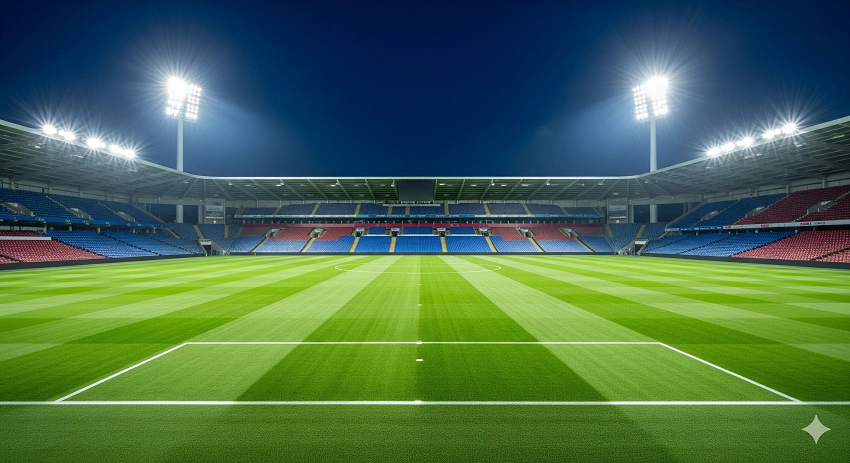
The lighting requirements for a Class I, televised basketball event are in a completely different league from recreational play. For international competitions like the FIBA World Cup or professional leagues like the NBA, the illumination standard is drastically higher, typically reaching up to 2000 lux or even more on the court surface. This high light level is necessary for the sensitive sensors of broadcast cameras to capture crisp, clear, and detailed images without excessive noise or grain. However, sheer brightness is not enough. Uniformity becomes a critical factor. The standard often dictates that the ratio between the minimum illuminance and the maximum illuminance (U1) should not exceed 0.5, or more commonly, the ratio of minimum to average (U0) must be very high, often 0.7 or greater. This ensures that there are no distracting dark spots or overly bright patches on the court as the cameras follow the fast-paced action. Color quality is also paramount. The color temperature must be in the range of cool white light, typically between 5000K and 6500K, which provides a crisp, daylight-like appearance that makes the court colors and players’ uniforms appear vibrant and true. Furthermore, the Color Rendering Index (CRI) must be exceptionally high, with a requirement of 90 or above (Ra). A high CRI, combined with a high R9 value for deep reds, is essential for accurately rendering the skin tones of players and the distinctive orange color of the basketball, ensuring a high-quality and realistic broadcast.
Why Is Anti-Glare Design Critical for Basketball Court Lighting?
Glare is a significant problem in sports lighting, and basketball presents unique challenges in this area. Glare is the visual discomfort or reduction in visibility caused by excessive brightness within the field of view. For a basketball player, intense glare can be more than just an annoyance; it can be a performance and safety hazard. Imagine a player looking up to shoot a free throw or grab a rebound, only to be momentarily dazzled by a bright floodlight shining directly into their eyes. This can cause them to lose sight of the ball or the rim, leading to a missed shot or a collision. This problem is particularly prominent in indoor basketball courts, where the highly reflective polished wood floor can exacerbate the issue by reflecting light upwards into players’ eyes. To combat glare, several strategies are employed. One is the use of fixtures with precision optics, such as deep-set lenses or reflectors, that tightly control the beam angle and direct light only where it is needed, preventing it from spilling into players’ eyes. Another approach, sometimes used in indoor arenas with high ceilings, is indirect lighting. This involves pointing the floodlights upwards towards the ceiling, which then acts as a large, diffuse reflector, bouncing soft, shadow-free light down onto the court. While indirect lighting provides exceptional comfort and eliminates glare, it is less efficient, as the ceiling absorbs some light, meaning additional fixtures and power are needed to achieve the required lux levels. For most outdoor courts, well-shielded, direct lighting with a calculated aiming angle is the most effective way to balance performance and glare control.
Why Is Flicker-Free LED Lighting Essential for Basketball?
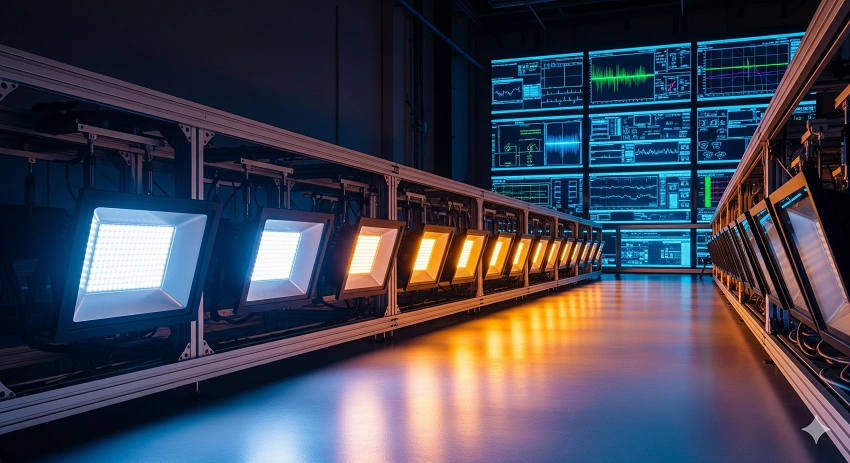
Flicker, or the stroboscopic effect, is an invisible menace in sports lighting that only becomes apparent under specific conditions, most notably under high-speed cameras. Flicker refers to rapid, repetitive fluctuations in light output. While the human eye might not perceive these micro-fluctuations directly, they can have a profound impact on the perception of fast-moving objects. For basketball, this is a critical issue. When a player makes a fast break, a pass is thrown, or a shot is taken, a flickering light source can create a stroboscopic effect, making the ball appear to have multiple “ghost” images or a trail behind it. This “double shadow” effect is not only disorienting for players but also makes for a very poor television broadcast, as the ball will appear blurry or multiplied. This is why professional broadcast standards require lighting with an extremely low flicker rate. High-quality LED floodlights, like those equipped with advanced constant-current drivers, can achieve a flicker rate of less than 0.3%. This means the light output is so stable and smooth that it is completely undetectable by even the most sensitive high-speed broadcast cameras. The result is a perfectly sharp, clear image of the ball at all times, ensuring that television viewers see the game exactly as it unfolds, without any distracting visual artifacts. For any court intended for televised or even streamed games, investing in true flicker-free LED lighting is non-negotiable.
Key Factors for Choosing Basketball Court LED Lights
The following table summarizes the critical parameters for different levels of basketball court lighting.
| Lighting Class | Typical Application | Illuminance (Lux) | Uniformity (U0) | CCT / CRI | Critical Features |
|---|---|---|---|---|---|
| Class I | Professional, TV Broadcast (NBA, FIBA) | 1500 – 2500+ lux | ≥ 0.7 | 5000K-6500K / CRI ≥ 90 | Flicker-free (<0.3%), High uniformity, Excellent glare control |
| Class II | Regional Competitions, College | 500 – 1000 lux | ≥ 0.6 | 5000K / CRI ≥ 80 | Good uniformity, Anti-glare optics |
| Class III | Recreational, Training, School | 200 – 300 lux | ≥ 0.5 | 5000K / CRI ≥ 70 | Adequate brightness, Basic glare reduction |
In conclusion, choosing the right LED basketball court flood lights requires a clear understanding of the intended use, from recreational play to professional broadcast. By following the guidelines for illuminance, uniformity, color temperature, CRI, and by prioritizing critical features like anti-glare optics and flicker-free drivers, you can create a lighting environment that enhances performance, ensures safety, and delivers an exceptional visual experience for players and spectators alike. For professional assistance and customized lighting designs, including detailed DiaLux simulations, consulting with a specialized provider like OAK LED ensures your basketball court is lit to perfection.
Frequently Asked Questions About Basketball Court LED Lighting
How many lumens do I need for a backyard basketball court?
For a standard 28m x 15m backyard or recreational court, you’ll need approximately 84,000 lumens to achieve the recommended 200 lux. With high-efficiency LEDs (around 170 lm/W), this translates to roughly 500 watts of total fixture power. However, a professional lighting design is recommended to ensure uniform coverage.
What color temperature is best for an indoor basketball court?
For indoor basketball courts, a cool white color temperature in the range of 5000K to 6500K is generally recommended. This range provides excellent contrast and clarity, making the ball and players stand out against the court surface. It also closely mimics daylight, which is ideal for both players and any video recording.
Can I use regular LED flood lights for a basketball court?
While you can use regular LED flood lights, they are not recommended for a proper basketball court. Sports lighting requires specific photometric distributions to ensure high uniformity and low glare. Regular flood lights may create hotspots, deep shadows, and excessive glare, which can be dangerous and detrimental to play. Purpose-built LED stadium flood lights are always the better choice.