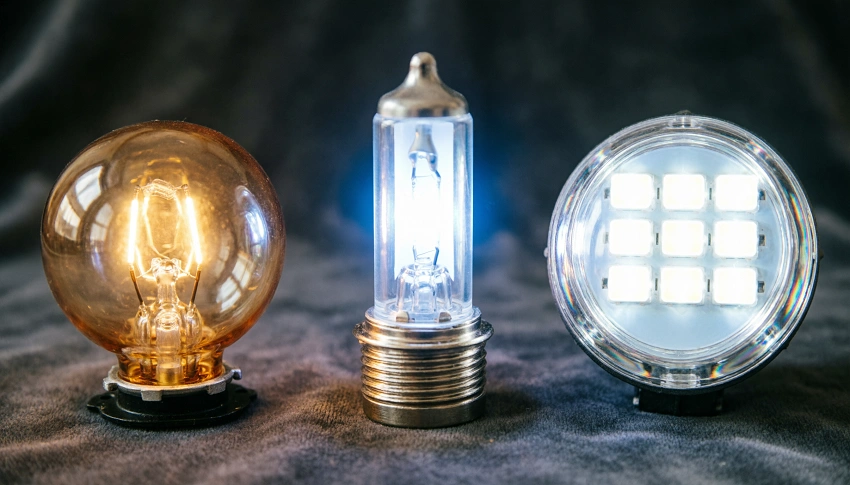
The Magic of Tunable LED Lighting
Modern LED lighting has transcended the simple function of illumination. Today, we can adjust not only how bright a light is but also the very color or “warmth” of the light it produces. This ability to tune both brightness and color temperature has revolutionized lighting design, enabling dynamic environments that can shift from an energizing, cool daylight for focused work to a relaxing, warm glow for evening relaxation. But how does this seemingly simple adjustment work? Beneath the surface of a tunable LED bulb or fixture lies a fascinating combination of physics, electronics, and material science. The principles governing these adjustments—mixing different LED spectra for color temperature and using pulse width modulation (PWM) for brightness—are the keys to understanding the versatility of modern lighting. This guide will demystify these technologies, explaining the concepts of color temperature, correlated color temperature (CCT), and the electronic wizardry of PWM dimming in a way that is both accessible and technically accurate.
What Is LED Color Temperature and How Is It Adjusted?
Color temperature is a way to describe the characteristic color of visible light emitted from a source. Contrary to what the name might suggest, it doesn’t refer to how physically hot a light gets, but rather the visual warmth or coolness of the light. The principle is rooted in the physics of an idealized object called a “black body radiator.” When a black body is heated, it glows with a color that changes predictably with temperature. At lower temperatures, it emits a warm, reddish-orange light. As the temperature increases, the color shifts to a “cool” white and eventually to a blueish-white. This color is measured in units called Kelvin (K). A candle flame has a very low color temperature, around 1800K (warm orange). A typical incandescent bulb is around 2700K-3000K (warm white). Noon daylight is much higher, around 5500K-6500K (cool white/blue). In the world of LEDs, achieving a specific color temperature is not about heating a filament. Instead, it’s about combining light from different sources. The most common method for creating white LEDs is to use a blue LED chip coated with a phosphor. The blue light excites the phosphor, which then emits yellow light, and the combination of blue and yellow light creates white. To adjust the color temperature, a fixture may contain multiple sets of LEDs: one set with a “warm” phosphor (producing a reddish-yellow light) and another set with a “cool” phosphor (producing a bluer light). By independently adjusting the brightness of the warm and cool LEDs and mixing their light, we can achieve any color temperature in between. Increase the power to the warm LEDs, and the overall light becomes warmer; increase the cool LEDs, and it becomes cooler. This is the fundamental principle behind tunable-white or CCT-adjustable LED lighting.
What Is the Black Body Radiator and Its Role in Defining Color Temperature?
The concept of the black body radiator is central to understanding color temperature. In physics, a black body is a theoretical object that absorbs all electromagnetic radiation that falls on it, reflecting none. When this perfect absorber is heated, it becomes a perfect emitter of radiation. The spectrum of light it emits is continuous and smooth, and its color is solely determined by its temperature. At around 3000K, a black body glows with a warm, yellowish-white light. At 5000K, its light is a neutral white, similar to midday sun. At 6500K and above, the light takes on a distinct blueish cast. Because the black body’s color changes in such a predictable way with temperature, it provides a perfect scale for measuring the color of light sources. When we say a light bulb has a color temperature of 3000K, we mean that its light appears the same color as a black body that has been heated to 3000 Kelvin. For many years, this concept applied almost perfectly to incandescent and halogen lamps, which are also thermal radiators and produce a continuous spectrum very similar to a black body. Their chromaticity coordinates (the precise definition of their color on a chart) lie almost exactly on the black body locus—the line on a chromaticity diagram that traces the color of a black body at different temperatures.
What Is Correlated Color Temperature (CCT) and Why Is It Used for LEDs?
The situation becomes more complex with light sources that are not thermal radiators, such as fluorescent lamps and, most importantly, LEDs. Unlike the sun or an incandescent filament, an LED produces light through electroluminescence, not heat. Its spectrum is not a smooth, continuous curve like a black body’s; it is often a combination of a sharp blue peak and a broader yellow phosphor emission. Because of this, the chromaticity coordinates of an LED almost never fall exactly on the black body locus. So, how do we describe its color? This is where Correlated Color Temperature (CCT) comes into play. CCT is the temperature of the black body radiator whose color most closely resembles that of the light source in question. It is a “best fit” value. On a chromaticity diagram, you find the point on the black body locus that is closest to the LED’s chromaticity coordinates, and that temperature is its CCT. For example, an LED with a CCT of 3000K will look very similar in color to a 3000K incandescent bulb, even though its spectrum is quite different. This is why CCT is the standard metric used for practically all white LED lighting today. It provides a simple, intuitive number that allows consumers and designers to compare and select the desired “warmth” or “coolness” of light from different manufacturers and technologies, even if their underlying spectral compositions vary. A lower CCT (2700K-3000K) gives a warm, cozy feel, while a higher CCT (4000K-6500K) provides a crisp, alert, and energetic ambiance.
How Is LED Brightness Adjusted?
Adjusting the brightness of an LED seems straightforward: just turn down the power, right? While that’s the basic idea, the method used to do it is critical for maintaining color quality and efficiency. The most common and effective method for dimming LEDs is called Pulse Width Modulation, or PWM. PWM is a technique for controlling the average power delivered to an LED without changing the voltage or current level at which it operates. It works like a very fast, electronic light switch. Instead of continuously reducing the current (which can cause the LED’s color to shift), PWM turns the LED on and off at a frequency so high that the human eye cannot perceive the flicker. The ratio of “on” time to “off” time determines the perceived brightness. This ratio is known as the duty cycle. A 100% duty cycle means the LED is on all the time, and it appears at its maximum brightness. A 50% duty cycle means it’s on half the time and off half the time; our eyes integrate this rapid pulsing and perceive it as being half as bright. A 10% duty cycle makes it appear very dim. This method is highly efficient because when the LED is on, it’s running at its optimal current, and when it’s off, it’s consuming zero power. The on/off switching is so fast (often thousands of times per second) that it’s completely imperceptible, providing a smooth, flicker-free dimming experience when implemented correctly.
How Does PWM Dimming Work at the Circuit Level?
The generation of a PWM signal is a fundamental task in electronics, often handled by a microcontroller or a dedicated driver IC within the LED power supply. The core of a simple PWM generator is often based on a comparator circuit that compares two signals: a constant-frequency sawtooth or triangle wave and a variable control voltage (the dimming level you set). The output of the comparator is a square wave that is “high” (turning the LED on) when the sawtooth wave is below the control voltage, and “low” (turning the LED off) when it is above. The width of these “high” pulses changes with the control voltage, hence the name Pulse Width Modulation. More practically, in an LED driver, the PWM signal is used to switch a transistor (like a MOSFET) on and off. This transistor is placed in series with the LED string. When the PWM signal is high, the transistor conducts, and current flows through the LEDs, turning them on. When the signal is low, the transistor cuts off, stopping the current and turning the LEDs off. The frequency of this switching is carefully chosen to be above the range that the human eye can detect, typically above 200 Hz for most applications, and often in the kHz range for high-end lighting to ensure no visible flicker. The dimming control you interact with—a knob, a slider, or a smart home app—simply changes the duty cycle of this internal PWM signal.
Why Is PWM Preferred Over Simple Current Reduction for Dimming?
The main reason PWM is the dominant dimming method for LEDs is color consistency. The color temperature (CCT) of an LED chip is dependent on the current flowing through it. If you simply reduce the direct current (DC) to dim the LED, the color of the light can shift. For example, a white LED might take on a slightly pinkish or greenish hue at lower currents. This is unacceptable for most lighting applications, especially where tunable white or high color quality is desired. By using PWM, the LED is always operated at its design current when it is on. This ensures that the color of the light remains stable and true across the entire dimming range. Whether the light is at 100% brightness or 10% brightness, the “on” pulses are at the full, correct current, so the color temperature doesn’t change. Only the duration of the pulses changes. This makes PWM the ideal method for maintaining precise color control. Another advantage is efficiency. Linear current reduction can sometimes lead to energy losses in the driver circuit. PWM, by switching the LEDs fully on and off, minimizes these transitional losses and keeps the overall system efficiency high, which is a core promise of LED technology.
Combining Color Temperature and Brightness Adjustment: Tunable White Lighting
The true power of modern LED lighting is realized when we combine adjustable CCT with PWM dimming. This is what enables “tunable white” or “human-centric lighting” systems. A tunable white fixture contains two independent strings of LEDs: one with a warm CCT (e.g., 2700K) and one with a cool CCT (e.g., 6500K). It also contains two independent PWM drivers. One driver controls the brightness of the warm LEDs, and the other controls the brightness of the cool LEDs. A central control system—which could be a simple two-gang dimmer switch or a sophisticated building automation system—sends two separate PWM signals. By varying the duty cycle of these two signals, you can independently set the intensity of each color string. To get a warm, dim light, you might send a strong PWM signal to the warm LEDs and a very weak one to the cool LEDs. For a bright, cool, energizing light, you would do the opposite. For a neutral white at medium brightness, you would balance the two signals equally. This method allows for seamless, continuous adjustment across the entire CCT and brightness spectrum, creating dynamic lighting environments that can mimic the natural progression of daylight from dawn to dusk, supporting human circadian rhythms and enhancing comfort, productivity, and well-being.
Key Concepts in LED Color and Brightness Control
The following table summarizes the core principles discussed in this guide.
| Concept | Definition | How It’s Adjusted in LEDs |
|---|---|---|
| Color Temperature (Black Body) | The color of light from a heated black body, measured in Kelvin (K). | Not directly adjustable in a single LED; used as a reference scale. |
| Correlated Color Temperature (CCT) | The “best match” of an LED’s color to a black body temperature. | By mixing light from separate warm and cool LED strings. |
| Brightness | The perceived intensity of the light. | Primarily by Pulse Width Modulation (PWM). |
| Pulse Width Modulation (PWM) | A technique of switching an LED on and off at high speed to control average brightness. | By changing the duty cycle (on/off ratio) of the power signal. |
| Duty Cycle | The percentage of time a PWM signal is “on” versus “off.” | Controlled by a dimmer or control system; a higher duty cycle = higher perceived brightness. |
In conclusion, the ability to adjust both the color temperature and brightness of LED lighting is a sophisticated interplay of optical design and electronic control. The principle of mixing warm and cool light sources allows us to navigate the CCT spectrum, while the precision of PWM dimming gives us flicker-free, color-stable control over intensity. Together, these technologies empower us to create lighting environments that are not only energy-efficient but also dynamically responsive to our needs, enhancing our comfort, productivity, and connection to the natural world.
Frequently Asked Questions About LED Color and Brightness
Can I dim any LED bulb?
No, not all LED bulbs are dimmable. You must specifically purchase bulbs labeled as “dimmable.” Using a non-dimmable LED bulb on a dimmer circuit can cause flickering, buzzing, and may eventually damage the bulb or the dimmer. Furthermore, dimmable LEDs often work best with compatible LED dimmer switches, as older dimmers designed for incandescent bulbs may not function correctly.
What is the best color temperature for a bedroom?
For a bedroom, a warm color temperature is generally recommended to promote relaxation and prepare the body for sleep. Look for LEDs with a CCT of 2700K to 3000K. This warm, yellowish light mimics the glow of a fire or traditional incandescent bulbs and helps create a cozy, calming atmosphere. Some advanced systems even use tunable white lighting to shift from cooler, energizing light in the morning to warm light at night.
Is PWM dimming bad for your eyes?
High-quality PWM dimming, operating at frequencies above 1-2 kHz, is imperceptible to the human eye and generally considered safe and comfortable. However, low-frequency PWM (below 200 Hz) can cause visible flicker, which can lead to eye strain, headaches, and discomfort for some individuals. When choosing dimmable LEDs, opt for reputable brands that specify “flicker-free” dimming to ensure a high PWM frequency and a comfortable visual experience.