What Is Illuminance and Why Does It Matter in Sports Lighting?
Illuminance is a fundamental concept in lighting design, referring to the total amount of light incident on a surface per unit area. In simpler terms, it measures how much light actually lands on and illuminates a given surface, whether that’s a playing field, a desk, or a roadway. It is quantified in units called lux, where one lux equals one lumen per square meter. Understanding illuminance is crucial because it directly determines visibility. For sports lighting, illuminance is not just about making the field bright; it’s about ensuring that players, officials, spectators, and television cameras can all see the action clearly and accurately. Poor illuminance can lead to misjudged balls, player injuries, and a subpar viewing experience. Therefore, sports lighting designers focus intently on two specific types of illuminance: horizontal and vertical. These two measurements address different visual needs and are governed by strict standards set by international sports federations. This guide will demystify these terms, explaining what they mean, how they are measured, and why they are the cornerstone of any professional sports lighting installation.
What Is Horizontal Illuminance in Sports Lighting?
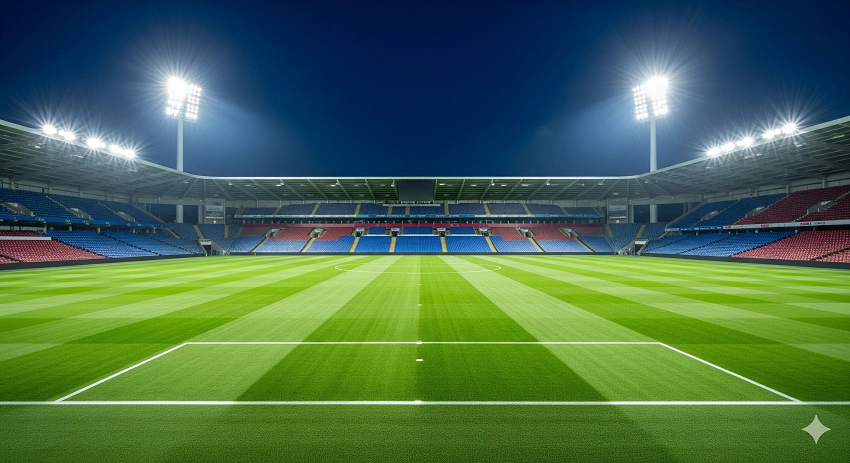
Horizontal illuminance is the measure of light falling onto a horizontal surface. In the context of a sports field, this is typically measured on an imaginary plane positioned one meter above the ground, parallel to the playing surface. Think of it as the light landing on a table placed on the field. Lighting engineers create a virtual grid over the entire playing area, and illuminance measurements are taken at each point on this grid to calculate the overall horizontal light levels. This type of illuminance is the most traditional and commonly referenced metric for general area lighting. It tells us how well-lit the ground itself is. For athletes, sufficient horizontal illuminance is essential for tracking balls that roll along the turf, judging distances to boundary lines, and seeing the immediate playing surface under their feet. For many amateur and community sports, meeting the required horizontal illuminance levels might be the primary goal. It provides a base level of safety and functionality, ensuring the field is uniformly lit so that players can move and compete without visual impairment from dark patches.
How Is Horizontal Illuminance Calculated and Measured?
The calculation of horizontal illuminance is a systematic process that ensures accuracy and uniformity. It begins with defining the area of interest, which is the main competition area of the sport. A grid system is then overlaid on this area. The spacing of the grid points is determined by standards such as those from CIE (International Commission on Illumination) or specific sport governing bodies like FIFA for football or World Athletics for track and field. A light meter with a cosine-corrected sensor is placed flat on the ground or on a tripod at the specified height, typically one meter. Measurements are taken at every grid intersection point. From these numerous data points, two key values are derived: the average horizontal illuminance (E_h avg) and the uniformity ratio. The uniformity ratio is critical and is often expressed as the minimum illuminance point divided by the average (U1 = E_min / E_avg) or the minimum divided by the maximum (U2 = E_min / E_max). A high uniformity, meaning the light levels are very consistent across the field, is just as important as the average brightness. It prevents players from having to adjust their vision between overly bright and overly dark areas, which can be disorienting and dangerous. For instance, a football field might require an average horizontal illuminance of 500 lux for training but 2000 lux for a televised international match, with a uniformity of 0.7 or higher.
What Is Vertical Illuminance and How Is It Different?
While horizontal illuminance measures light on the ground, vertical illuminance measures the amount of light falling onto a vertical surface. Imagine holding a flat board upright in front of you; the light hitting that board is the vertical illuminance. This measurement is far more complex because the orientation of that “board” matters. In sports lighting, we measure vertical illuminance on a plane that is perpendicular to the playing surface, and crucially, we define its direction. Typically, this is done at a height of 1.5 meters above the ground, roughly the height of a player’s torso and face. The key difference is that vertical illuminance is not a single number for a point on the field. It depends on the direction from which you are looking. For example, the vertical illuminance on a player as seen from the main camera position will be different from the vertical illuminance on that same player as seen from the sideline stands. Therefore, lighting designers must calculate and specify vertical illuminance for multiple key viewing directions. This is what makes it so vital for televised events, as it directly dictates how well the camera sensor captures the athletes.
Why Is Vertical Illuminance Critical for Televised Sports?
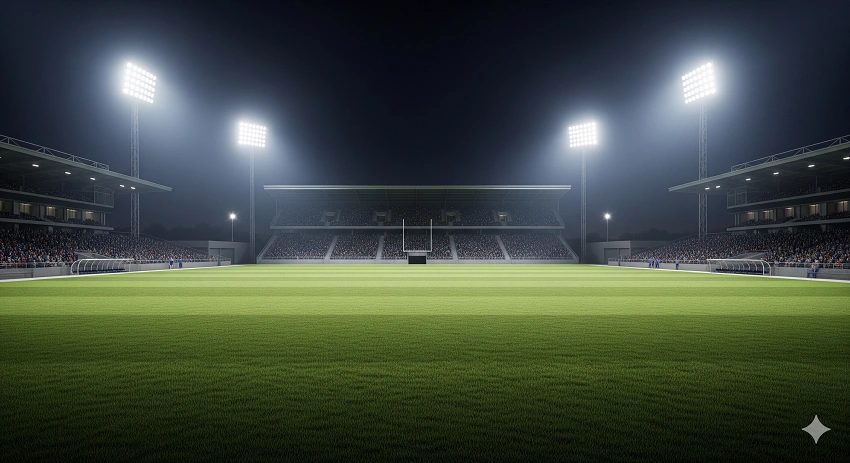
The primary reason vertical illuminance is emphasized for broadcast competitions is that television cameras capture light reflected off the subjects. The players, the ball, and the lines on the field are all vertical or near-vertical surfaces from the camera’s perspective. If there is plenty of light on the ground (high horizontal illuminance) but insufficient light on the players’ faces and bodies (low vertical illuminance), the broadcast will appear dark, flat, and lacking in detail. The athletes’ faces will be in shadow, and fast-moving action will be hard to follow. To achieve a high-quality broadcast, lighting standards require specific levels of vertical illuminance towards the main camera. For instance, a stadium hosting a FIFA World Cup match must achieve a certain minimum vertical illuminance towards the primary camera position to ensure that every blade of grass and every player’s expression is rendered with clarity. Furthermore, high vertical illuminance with good uniformity across the field ensures that the camera does not have to constantly adjust its exposure as it follows the play from one end of the field to the other, providing a smooth and professional viewing experience. This is why the transition from simple area lighting to professional sports lighting is marked by a shift in focus from purely horizontal to a careful balance of both horizontal and vertical illuminance.
How Do Horizontal and Vertical Illuminance Work Together in Sports?
In any professional sports lighting design, horizontal and vertical illuminance are not competing metrics but complementary ones. They work in tandem to create a complete visual environment. Think of horizontal illuminance as providing the foundation, a well-lit stage. It ensures the playing surface itself is clearly defined and safe. Vertical illuminance then brings the actors on that stage to life, making them visible and three-dimensional to both the live audience and the cameras. A well-designed lighting system will meticulously balance both. For example, a tennis court requires high vertical illuminance so that the fast-moving ball is visible against the background, but it also needs excellent horizontal uniformity so that players can accurately judge the ball’s bounce on the court surface. Similarly, in a football stadium, the lighting must be arranged to flood the pitch from multiple angles. This ensures that a player running in one direction is well-lit from the front for one camera and from the side for another, providing comprehensive coverage. The interaction between these two types of illuminance also affects the modeling of players, creating highlights and shadows that allow the human eye and camera sensors to perceive depth and movement accurately.
What Are the Key Calculations and Considerations for LED Sports Lights?
Designing an LED sports lighting system involves precise calculations that go far beyond simply adding up wattage. The process starts by defining the competition area and the total area, which includes the competition area plus the safety perimeter. The required illuminance levels are then determined by the sport, the level of play (from recreational to international broadcast), and the governing body’s standards. For instance, a badminton hall for club play has vastly different requirements than an Olympic swimming pool. The calculations must account for the mounting height of the lights, the beam angles of the LED fixtures, the aiming points, and the reflectivity of the surroundings. Specialized lighting design software is used to simulate the entire installation. Engineers input the exact specifications of the LED luminaires—their lumen output, photometric distribution, and color temperature—and run thousands of calculations to model the resulting horizontal and vertical illuminance across the entire grid. These simulations produce the predicted average illuminance, uniformity ratios, and glare ratings (GR), which are then compared against the target standards. The goal is to optimize the number, placement, and aiming of fixtures to meet or exceed all requirements with maximum energy efficiency.
Why Are Uniformity and Glare as Important as Brightness?
While achieving the correct illuminance levels is the primary target, two other factors are equally critical for a successful sports lighting installation: uniformity and glare control. Uniformity, as mentioned earlier, ensures that the light distribution is even. Poor uniformity creates zones of shadow and bright spots. For an athlete, moving from a bright area into a darker one can be momentarily blinding, causing them to lose track of the ball or an opponent. For television, poor uniformity makes the broadcast look unprofessional and can confuse automatic camera exposure systems. Glare is another significant concern. Glare is the sensation of discomfort or disability caused by excessively bright light sources within the field of view. For a player looking up to catch a high ball, a poorly shielded floodlight can cause disabling glare, making it impossible to see the ball. This is a serious safety hazard. Modern LED sports lights are designed with advanced optics and glare control features, such as visors and precise beam shaping, to direct light only where it is needed and keep it out of the eyes of players, officials, and spectators. A good lighting design report will always include a Glare Rating (GR) calculation to ensure it falls within acceptable limits for the specific sport.
Practical Examples: Illuminance Requirements for Different Sports
The specific requirements for horizontal and vertical illuminance vary dramatically between sports. Here are a few practical examples to illustrate these differences, based on common international standards. These are not absolute but serve to highlight how the nature of the sport dictates its lighting needs.
| Sport / Level | Avg. Horizontal Illuminance (E_h) | Avg. Vertical Illuminance (E_v) towards camera | Primary Consideration |
|---|---|---|---|
| Football (Soccer) – Training | 200 lux | Not specified | Even ground illumination for safety |
| Football (Soccer) – National TV Broadcast | 1500 – 2000 lux | 1200 – 1800 lux (towards main camera) | Balanced for player visibility and broadcast clarity |
| Tennis – International TV | 1500 – 2000 lux | 1000 – 1400 lux (multiple directions) | High vertical for ball tracking against sky/background |
| Baseball – Professional | 1500 – 2500 lux (infield) | 1200 – 2000 lux (towards home plate) | Extremely high vertical for high-speed ball tracking |
| Indoor Basketball – TV Broadcast | 1500 – 2000 lux | 1000 – 1500 lux | Uniformity is critical to avoid shadows on the court |
These examples show that as the level of competition rises, so do the demands on the lighting system. The simple goal of lighting the ground evolves into the complex task of illuminating a three-dimensional space for a global television audience, highlighting why a deep understanding of both horizontal and vertical illuminance is essential for any professional lighting project.
Frequently Asked Questions About Sports Lighting Illuminance
What is the difference between lux and lumens?
Lumens measure the total amount of light emitted by a source (like an LED flood light). Lux measures the amount of that light that actually falls on a surface (like the football field). Think of lumens as the total water a sprinkler sprays, and lux as how much water lands on a specific square meter of your lawn. For sports lighting, we care most about the lux on the field.
Why is uniformity ratio important in sports lighting?
Uniformity ensures that the light level across the entire playing field is consistent. Without good uniformity, players would have to contend with dark patches and bright spots, which strains their eyes and makes it difficult to track the ball consistently. For example, a football player receiving a pass might misjudge the ball if it moves from a well-lit area into a shadow. High uniformity creates a fair and safe playing environment.
How is vertical illuminance measured for a stadium?
Vertical illuminance is measured using a light meter held vertically, perpendicular to the ground, at a height of about 1.5 meters. Crucially, it is measured in a specific direction. For a stadium, measurements are typically taken towards the four main camera positions. This ensures that players are well-lit from the angles that will be captured for broadcast.