Understanding the Unique Lighting Challenges of a Football Field
Lighting a football field is one of the most complex and demanding tasks in sports lighting design. Unlike an indoor arena with a low ceiling, a football field is a vast outdoor (or large indoor) space where players, officials, and a small ball must be visible from all angles, often for high-definition television broadcast. The challenge is not simply to make the field bright, but to do so uniformly, without glare, and in a way that meets the specific visual needs of players at every position. A poorly lit field can lead to misjudged balls, player injuries, and a subpar experience for spectators. The lighting must illuminate not only the horizontal playing surface but also the vertical planes, so that players and the ball are visible against the background of the stands or the night sky. This requires a deep understanding of the field’s dimensions, the level of play, and the geometry of light placement. Whether it’s a small 5-a-side training pitch or a massive stadium hosting an international tournament, the fundamental principles of good lighting design remain the same, but their application must be tailored to the specific requirements of the venue. This guide will explore the key football lighting requirements and the two primary installation plans used to achieve them: the four-corner layout and the side (or flank) layout.
What Are the Standard Sizes for Different Types of Football Fields?
The first step in any lighting design is to understand the precise dimensions of the playing area, as this dictates the number and placement of light poles or fixtures. Football field sizes vary significantly depending on the format of the game. For 5-a-side football, the competition venue is rectangular, with a length ranging from 25 to 42 meters and a width from 15 to 25 meters. For international 5-a-side competitions, the requirements are more stringent, with a length of 38 to 42 meters and a width of 18 to 22 meters. The 7-a-side game, often played by younger age groups, calls for a larger field, typically 65 to 68 meters in length and 45 to 48 meters in width. The most common format, 11-a-side football, has the widest range of permissible dimensions according to the laws of the game. The length can be between 90 and 120 meters, and the width between 45 and 90 meters. However, for international competition matches, such as those governed by FIFA, the dimensions are standardized to a much narrower range: a length of 105 to 110 meters and a width of 68 to 75 meters. A standard pitch for top-level matches is often cited as 105 meters by 68 meters. Knowing these dimensions is crucial for calculating the total area that needs to be illuminated and for determining the optimal mounting heights and positions for the floodlights to ensure complete and uniform coverage.
What Are the Illumination Level Requirements for Different Levels of Play?
The required amount of light on a football field, measured in lux, is not a fixed number. It varies dramatically based on the level of competition and whether the event is being televised. The illumination standards are typically categorized into several classes, from simple training activities to international broadcast events. For basic training and recreational entertainment activities, an average illuminance of 200 lux is generally sufficient. This level allows players to see the ball and each other safely for practice. For amateur club competitions and local matches, the requirement rises to 300 lux. When we move to professional competitions that are not televised, a level of 500 lux is typically required to provide the higher visibility needed for faster-paced, higher-stakes games. The demands change significantly when television enters the picture. For general TV broadcast of matches, the requirement jumps to 1000 lux on the playing surface. This ensures that standard-definition cameras can capture clear, detailed images. The highest level of lighting is reserved for major international competitions broadcast in high-definition (HDTV), such as the FIFA World Cup or UEFA Champions League finals. For these events, the illumination level must reach 1400 lux or even higher. Furthermore, specific requirements exist for TV emergency lighting, often around 1000 lux, which must be available instantly in case of a main power failure to ensure the broadcast can continue or the event can be safely concluded. It is also worth noting that indoor football venues often have slightly higher base requirements due to the lack of any ambient light and the reflective nature of the environment, with training at 300 lux and amateur competition at 500 lux being common starting points.
What Are the Main Installation Plans for Football Field Lighting?
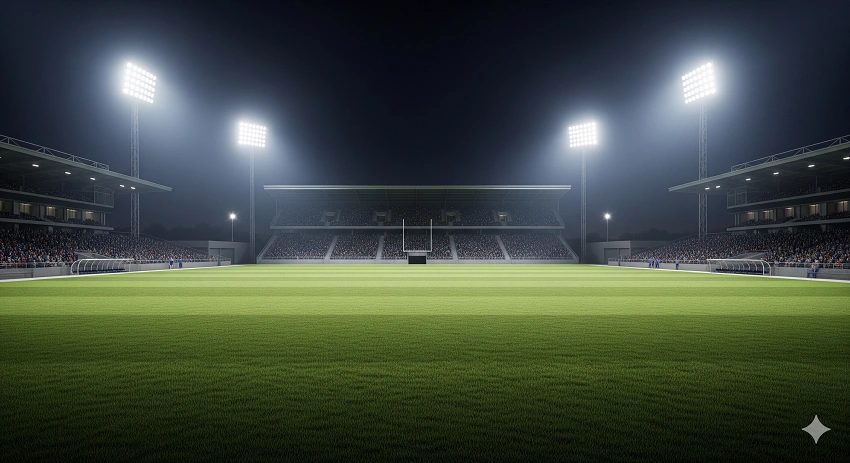
There are two primary approaches to positioning floodlights for a football field: the four-corner layout and the side (or flank) layout. Each has its own characteristics, advantages, and ideal applications. The choice between them depends on factors such as the presence of a spectator stand, the stadium architecture, budget, and the required lighting level. The four-corner layout is a classic and widely used method, especially for stadiums without a roof that can support lighting. It involves placing four tall light poles, one at each corner of the field, outside the playing area. The side layout, on the other hand, involves positioning light sources along the sides of the field. This can be further divided into two sub-categories: the light belt arrangement, where luminaires are mounted continuously or in segments along the edge of a roof or stand, and the multi-pole arrangement, where multiple, slightly shorter poles are placed on each side of the pitch. Understanding the nuances of each plan is essential for selecting the right solution for a given project.
How Does the Four-Corner Layout Work and Where Are the Poles Placed?
In the four-corner layout, four high masts are positioned outside the four corner zones of the stadium. A primary goal is to place these poles outside the normal line of sight of the athletes to minimize glare and distraction. The typical location for these corner poles is on the extension of the diagonal of the football field. However, the exact position is governed by strict angular constraints designed to protect the vision of key players, especially the goalkeeper and attacking players in the corners. For sites without TV broadcast requirements, the poles are generally placed at a minimum of 5° outside the center line and 10° outside the goal line (the bottom line). This creates a permissible zone, often visualized as a red area in design diagrams, where poles can be safely located. For stadiums designed for TV broadcast, these angles are more restrictive. The angle outside the goal line must not be less than 15° to ensure that cameras have a clear, glare-free view of the action in the critical goalmouth areas. Beyond pole placement, the aiming of the floodlights themselves is critical for glare control. A fundamental rule is that the projection angle of the football field lights—the angle of the beam relative to the vertical—should not be greater than 70°. This ensures that the shading angle, the angle above the horizontal where the light source is hidden from view, is greater than 20°, which is a key benchmark for minimizing glare for players looking up. Furthermore, the installation brackets for the floodlights are typically tilted forward by about 15°. This intentional tilt prevents the upper rows of lights in a cluster from casting a shadow on the lower rows, which would result in significant light loss and create uneven illumination on the field.
What Is the Side Layout (Light Belt and Multi-Pole Arrangement)?
The side layout, also known as the flank layout, is the most common solution for stadiums that have spectator stands with roofs. The most prevalent form is the light belt arrangement. In this design, the roof edge of the stand provides a natural and elevated platform to support the lighting system. Instead of four tall corner poles, a continuous or segmented “belt” of floodlights is mounted along this roof edge. This method offers several advantages over the four-corner layout. Because the lights are positioned much closer to the field and at a lower mounting height than a corner pole, they can achieve a more efficient and controlled light distribution. The light is directed more directly onto the pitch, resulting in better illumination and less light spill. The position of this light belt, however, is subject to its own strict rules to protect sightlines. The lighting installation cannot be placed within a critical zone defined from the goal line. Based on the midpoint of the goal line, a 15° angle is projected onto each side. No lighting equipment can be placed within this 15° zone, ensuring that a goalkeeper or defender looking towards the corner flag is not blinded by a directly mounted light. More recent regulations have expanded this restricted area. It now includes a space that is 20° outward from the goal line and up to an angle of 45° to the horizontal, further safeguarding the vision of players and officials. The required mounting height for a light belt is calculated based on its distance from the field. A simple formula, h = d * tan(ø), where d is the distance from the midpoint to the light pole and ø is a minimum angle (typically at least 25°), is used to ensure the lights are high enough to project light over the entire field.
The second type of side layout is the multi-pole arrangement. This is often used in stadiums without a continuous roof or in situations where a light belt is not feasible. Instead of one continuous line of lights, multiple individual poles are placed on both sides of the pitch. This approach offers great flexibility, as the number and height of the poles can be tailored to the specific dimensions and requirements of the field. Common configurations include a four-pole arrangement (two on each side) or an eight-pole arrangement (four on each side). Generally, the poles in a multi-pole arrangement can be slightly lower than the four-corner poles because they are closer to the field, but they must still be tall enough to achieve the desired projection angles. The same critical rules for avoiding the goalkeeper’s line of sight apply. With the midpoint of the goal line as a reference, poles cannot be placed within at least 10° on either side of that line. This ensures that players in the most visually demanding positions on the field are not subjected to direct glare from the floodlights, maintaining a safe and fair playing environment.
Frequently Asked Questions About Football Field Lighting
How many lux are needed for a professional televised football match?
For a professional televised football match, the required illuminance is typically 1000 lux for standard-definition broadcasts. For major international tournaments broadcast in high-definition (HDTV), such as the FIFA World Cup, the requirement is significantly higher, often 1400 lux or more on the playing surface, with specific uniformity and color temperature requirements for optimal camera performance.
What is the advantage of a four-corner lighting layout?
The four-corner layout, using tall poles at each corner of the field, is often preferred for stadiums without large spectator stands or roofs. Its main advantage is that it positions the light sources away from the field, minimizing obstruction and allowing for a clear, open view from the stands. It is also a versatile solution that can be adapted to many different stadium geometries, though it requires very tall poles to achieve good uniformity.
Why are there restricted zones for placing light poles near the goal line?
These restricted zones, typically defined by angles from the goal line, are designed to protect the vision of the goalkeeper and attacking players. When a player is facing the corner flag or tracking a high ball, a light source placed within this zone would be directly in their line of sight, causing disabling glare. The restrictions ensure that all floodlights are positioned outside this critical visual field, creating a safer and fairer environment for players.