The Hidden Value of an LED That Lasts
When you purchase an LED light, you are buying more than just illumination; you are investing in years of reliable, energy-efficient service. The promise of a 50,000-hour lifespan is one of the primary reasons we choose LED over older technologies. However, this longevity is not an accident. It is the result of rigorous engineering and, crucially, a series of demanding quality control procedures performed long before the lamp ever reaches a store shelf. Among the most important of these procedures is the aging test. While it might sound like a simple “burn-in” period, the aging test is a sophisticated and multifaceted process designed to weed out potential failures, verify thermal performance, and ensure that every component, from the LED chip to the driver, can withstand the rigors of real-world use. For manufacturers like OAK LED, this test is not a box-checking exercise; it is a fundamental commitment to delivering on the brand’s promise of quality. This article will explore the necessity of aging tests, detailing how they simulate years of use in a matter of hours or days to guarantee that when an LED lamp is finally installed, it is ready to perform at its maximum effect continuously and reliably.
What Is an LED Aging Test and Why Is It Performed?
An LED aging test, also known as a burn-in test, is a quality assurance procedure where finished LED luminaires are operated under controlled, and often accelerated, conditions for an extended period before they are approved for shipment. The fundamental purpose is to identify and eliminate early failures—the so-called “infant mortality” phase of a product’s life. Electronic components, including the LEDs and the driver, can have latent defects that are not caught by standard visual inspection or functional testing. These defects, such as a weak solder joint, a slightly misaligned component, or a microscopic flaw in an LED chip, might not cause a failure during a brief 5-minute test. However, after a few hours of operation, the thermal stress and electrical load can cause these weak points to fail catastrophically. By running the lights for a longer period—typically 24 to 48 hours or more, and sometimes up to a week for high-reliability applications—the aging test forces these infant mortality failures to occur in the factory, where the faulty unit can be repaired or discarded, rather than in the customer’s hands. It is a final, critical filter that ensures only robust, fully-functional products make it to the market, safeguarding the manufacturer’s reputation and the end-user’s investment.
How Is a Standard Aging Test Conducted?
The conditions for a standard aging test are carefully specified to be both controlled and representative of real-world use. The test is typically conducted in an environment without forced ventilation directly on the units, to allow them to reach their natural operating temperature, and at a stable ambient temperature, usually maintained between 20°C and 30°C (68°F to 86°F). This controlled ambient temperature is crucial for repeatability and for ensuring that the test results are not skewed by external environmental factors. The luminaires are mounted in a way that mimics their intended installation, allowing for normal heat dissipation through their designed heat sinks. They are then “normally ignited,” meaning they are powered on and operated according to their specified conditions. Crucially, they are powered at their nominal rated voltage or, in some cases, at the maximum voltage of their rated range to simulate a worst-case scenario for the power supply. During this period, operators or automated monitoring systems may periodically check for flicker, listen for any unusual buzzing from the driver, and verify that the light output remains stable. This systematic process provides the first layer of assurance that the basic functionality and assembly quality of each luminaire meets the required standard.
How Does Aging Testing Address the LED Mortality Rate?
The concept of “mortality rate” in LEDs is different from traditional bulbs, but failures can and do occur, especially early in life. Under normal rated voltage and current, a well-assembled LED module from a reputable manufacturer should have a very low immediate failure rate. However, the real world is not always “normal.” Power grids experience surges, spikes, and sudden outages. The aging test is designed to simulate and anticipate these stressful events. To ensure a lamp can withstand these common occurrences, the aging process often includes more rigorous elements beyond simple continuous operation. This may involve subjecting the lamps to a series of power cycles—turning them on and off rapidly or at specific intervals—to test the inrush current tolerance of the driver and the robustness of the entire system. It can also include running the lamps at slightly elevated voltages for short periods to stress-test the power supply components. The goal is to verify that the power supply structure is qualified, that all welding positions are firmly soldered and can handle thermal expansion and contraction, and that the overall assembly line’s workmanship has reached a standard capable of withstanding real-world electrical disturbances. A lamp that passes this type of stress testing is far less likely to fail when faced with a power surge or a momentary outage in its actual installation.
Why Is Thermal Stress Testing Critical for LED Heat Dissipation?
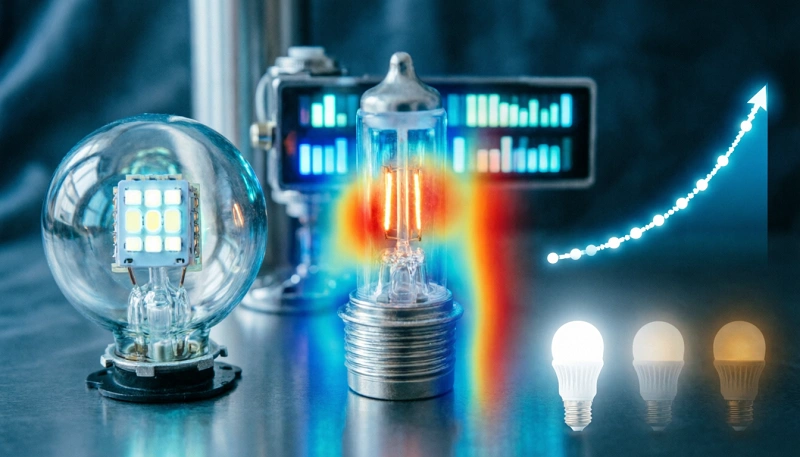
Perhaps the single most critical factor in LED longevity is effective heat dissipation. As discussed in previous articles, the heat generated at the LED junction, if not properly managed, will rapidly accelerate lumen depreciation and lead to premature failure. The aging test plays a vital role in verifying the thermal design of a luminaire. While thermal simulations are done during the design phase, the aging test provides empirical proof. During the test, the LED lamp is operated continuously, allowing it to reach its maximum thermal equilibrium temperature. This is often done at an elevated ambient temperature or at the maximum rated load to push the thermal system to its limits. Technicians may use thermal imaging cameras or thermocouples to measure the temperature at critical points: the LED junction (indirectly), the heat sink, the driver components, and the housing. The key pass/fail criteria are that the internal structure and components are not destroyed or degraded by this prolonged thermal stress, and that the temperature of each part stabilizes and does not continue to rise over time. A well-designed luminaire will reach a stable temperature plateau, indicating that the heat sink is effectively dissipating the heat into the environment. If the temperature continues to climb, it signals a fundamental thermal management failure, meaning the lamp would have a drastically shortened lifespan in the field. The aging test is the final, undeniable verification that the cooling solution is adequate for the job.
How Does Aging Testing Ensure Stable Luminous Efficiency and Electrical Performance?
The luminous efficiency and stability of an LED lamp over its lifetime are directly tied to the quality and consistency of its internal power supply, or driver. The driver’s job is to convert the often-fluctuating AC mains power into a stable, regulated DC current for the LEDs. The primary factor affecting long-term luminous stability is the driver’s ability to maintain this constant current despite variations in input voltage and temperature. During the aging test, the combination of the driver and the LED modules is put through its paces. The test monitors for any signs of instability, such as visible flicker (which can be a sign of a poorly regulated output) or a gradual drift in light output. While the aging test is not a full LM-80/TM-21 lifespan projection, it is a critical check for “out of the box” electrical performance. It verifies that the power supply’s rectification and regulation circuits are functioning correctly and that the over-voltage protection devices are working as intended. If there is a subtle defect in the driver’s components—like a failing capacitor or a poorly calibrated control chip—it will often manifest during a multi-day burn-in test as a failure, intermittent flicker, or excessive heat. By catching these issues early, the aging test guarantees that the lamp will deliver its rated luminous efficiency from the moment it is installed.
Why Is a Flicker Test an Essential Part of the Aging Process?
A specific and crucial aspect of the aging test is the flicker test. Flicker, or rapid, periodic fluctuations in light output, can be imperceptible to the naked eye or quite obvious and annoying. It is caused by imperfections in the driver’s output current, often related to the ripple from the AC-to-DC conversion stage. While some very high-frequency flicker is harmless, low-frequency flicker can cause eye strain, headaches, and even safety issues in industrial environments with rotating machinery. During the aging test, each lamp is visually inspected, and often monitored with photodetectors, for any signs of flicker. This test is necessary because flicker issues can arise from specific component tolerances or assembly errors. For example, a mistake during the packaging process of the LED light engine or a slightly off-value component in the driver’s filtering stage might only become apparent after the lamp has warmed up and been running for some time. The aging test, by operating the lamp for an extended duration, provides the opportunity to observe these issues. Ensuring a flicker-free, stable, and normal operation is the final step in certifying that the LED light piece, its driver, and all connections are working in perfect harmony to deliver a high-quality, reliable lighting experience.
Key Objectives of LED Aging Tests
The following table summarizes the main goals and methods of the LED aging test process.
| Test Objective | What It Verifies | Typical Test Method |
|---|---|---|
| Infant Mortality / Failure Rate | Identifies weak components, poor solder joints, and latent manufacturing defects. | Continuous operation at nominal or elevated voltage for 24-48+ hours. |
| Thermal Stress / Heat Dissipation | Confirms the heat sink and thermal path can manage the load without overheating. | Run at maximum load temperature; monitor with thermal sensors/imaging for stability. |
| Power Supply Robustness | Tests the driver’s ability to handle voltage fluctuations, surges, and power cycling. | Rapid on/off cycling, operation at max/min rated voltage, over-voltage protection checks. |
| Luminous Stability & Flicker | Ensures stable, flicker-free light output and consistent electrical performance. | Visual inspection and photodetector monitoring for any fluctuations or flicker. |
In conclusion, the aging test is far more than a simple “run-in” period. It is a comprehensive, multi-faceted quality control process that simulates the stresses of early life to ensure that every LED luminaire leaving the factory is robust, reliable, and ready to deliver on its promise of long-lasting, high-performance illumination. For the consumer, it represents an unseen but essential guarantee of quality. For a manufacturer like OAK LED, it is a fundamental step in building trust and upholding a reputation for excellence in a competitive global market. It is the final, critical assurance that when you install an OAK LED product, it will provide continuous, maximum-effect lighting for years to come.
Frequently Asked Questions About LED Aging Tests
How long does a typical LED aging test last?
The duration of an aging test can vary depending on the manufacturer’s quality standards and the type of product. For most commercial LED lighting, a burn-in period of 24 to 48 hours is common. For more critical applications or higher-tier products, this can be extended to 72 hours, 96 hours, or even a full week to ensure the highest level of reliability and to weed out any potential early-life failures.
Does an aging test shorten the overall life of the LED?
No, a properly conducted aging test does not meaningfully shorten the overall life of an LED. The 24 to 48 hours of operation represent a tiny fraction of an LED’s expected 50,000+ hour lifespan (less than 0.1%). The test is designed to identify components that would have failed very early anyway, protecting the customer from inconvenience and ensuring that only the most robust products are shipped.
Can I perform an aging test on LEDs I already have installed?
While you can certainly run your lights continuously, you cannot perform the type of controlled, stress-inducing aging test done in a factory. Factory tests often involve elevated voltages, rapid power cycling, and precise thermal monitoring that are not possible in a standard installation. For installed lights, the best practice is simply to observe them for any early flicker or failure during their first few days of use, which would be covered under warranty.